 Mainstream Weekly
The situation in the Darjeeling hills has once again deteriorated with an indefinite strike to project the demand for a separate State of Gorkhaland paralysing life and leaving countless tourists stranded. As we go to press there are signs of further detrioration with the disturbing prospects of ethnic clashes breaking our between activists of the Gorkha Janmulti Morcha on the one side and the Amra Bangali outfits of Bengali chauvinists on the other in Siliguri. In this scenario the (…)
Home > Archives (2006 on) > 2008 > June 14, 2008
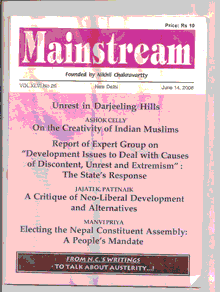 June 14, 2008
EDITORIAL
– Unrest in Darjeeling Hills
ASHOK CELLY
– On the Creativity of Indian Muslims
Report of Expert Group on “Development Issues to Deal with Causes of Discontent, Unrest and Extremism” : The State’s Response
JAJATI K. PATTNAIK
– A Critique of Neo-Liberal Development and Alternatives
MANVI PRIYA
– Electing the Nepal Constituent Assembly: A People’s Mandate
-
 Unrest in Darjeeling Hills
15 June 2008, by SC -
To Talk about Austerity…!
15 June 2008, by Nikhil ChakravarttyThe air is thick with talk about the economic crisis facing the country. The Finance Minister has called it “ a grave economic crisis”. “We have not experienced anything similar in the history of independent India,” he has said.
In Parliament, in newspaper offices, in the university campus, in Chambers of Commerce, the talk centres round the urgent need to borrow, to contract loans so that our economy could be sustained and the nation does not collapse under debts.
In other words, our (…) -
Innovative Measures for Inclusive Women’s Reservation
15 June 2008, by Iqbal A AnsariReservation for women in Parliament and Assemblies derives legitimacy from the norms of inclusive democracy, and from the human rights norms requiring institutions to be gender sensitive. But these very norms would also like the Indian legislative bodies to reflect the diversity based on religious and ethnic minorities. Similarly the constitutional promise of social justice to weaker sections requires their political empowerment in terms of their share in legislatures.
The apprehensions (…) -
On the Creativity of Indian Muslims
15 June 2008, by Ashok CellyOne of the most amazing phenomena of our cultural history is the extraordinary creativity of Indian Muslims. They have made outstanding contributions not only to music—something which is generally acknowledged—but also to literature, theatre, films and painting etc. Their contribution is out of all proportion to their demographic presence—a bare 10 per cent of the total Indian population. And this (their enormous contribution) holds true not only of the period before indepen-dence but also (…)
-
The State’s Response
15 June 2008The following is one chapter of the Report of the Expert Group on “Development Issues to Deal with the Causes of Discontent, Unrest and Extremism”, set up by the Planning Commission, in May 2006. With D. Bandyopadhyay, the architect of ‘Operation Barga’ of West Bengal in the eighties and former Secretary, Rural Development, Government of India, as the Chairman, the Group consisted of sixteen members. Besides D. Bandyopadhyay, the other members were S.R. Sankaran, Dr B.D. Sharma, Kamala (…)
-
Capabilities’ Qualifier: Can the Gap be Bridged?
15 June 2008, by Uttam SenThe development of capabilities can liberate people from ancient snares and provide them lives of reasonable dignity and contentment. The ability to lead healthy lives, read and write, form opinions and share them constructively with one’s milieu are the foundations on which the idea of composite well-being has been built. The skills required to draw incomes and nurture livelihoods are integral to the process but their acquisition is not spontaneous and is dependent on a host of (…)
-
West Bengal: Panchayat Election Outcome shakes the Roots of Left Politics
15 June 2008, by Amitava MukherjeeThe results of the just concluded panchayat elections in West Bengal have opened up such possibilities and speculations as has never been witnessed in the 30-year-old Left rule in the State. The reverses suffered by the Left, particularly the CPM, have been so intense that the aftermath has shaken the roots of Left politics in the State. The CPM has been so unnerved that it has decided to go slow on its industrial policy whose principal feature is to please big capitalists at any cost by (…)
-
A Critique of Neo-Liberal Development and Alternatives
15 June 2008, by Jajati K PattnaikNeo-liberal development based on the foundations of free market, free trade, and integration building policies envisages a world order glowing with growth and prosperity. Globalisation as the instrument of this philosophy espouses the diffusion of knowledge and technology stretching de-territorialised economic growth. The driving forces behind this process are transnational corporations and international financial institutions intended to create a new epoch in international relations with a (…)
-
Practical Steps to Peace in Kashmir
15 June 2008, by Neenu Rishi ChanchalBOOK REVIEW
Crafting Peace in Kashmir: Through a Realist Lens by Verghese Koithara; Sage Publications, New Delhi.
This edited volume examines the India-Pakistan conflict in depth, and comparative analyses with conflicts as observed in Northern Ireland and Sri Lanka as well as the Israel-Palestinian hostilities have been presented to provide an analytical backdrop through a realist’s lens.
Koithara, in his well-researched book, argues that the dominant prevailing view about the Kashmir (…) -
Electing the Nepal Constituent Assembly: A People’s Mandate
15 June 2008, by Manvi PriyaThe much awaited and negotiated elections to the Constituent Assembly (CA) in Nepal took place on April 10, 2008. Having studied the debates around Constitution-building and interviewed the actors of Nepalese politics and civil society last year, it was exciting to witness the CA elections and glean from them the possibilities of a new Nepal.
South Asian Partnership-International (SAP-I) had organised an Election Observation Team of South Asians for the historic event. It formed three (…)