 Mainstream Weekly
The Trust-Vote debate on July 21 and 22 has generated unexpected political consequences. The ruling UPA won in the number’s game but not in terms of the half-way mark through declared voting intentions. The PM and the Foreign Minister focused on the India-USA Nuclear Deal. The Opposition, on the other hand, focused on the entire performance in the context of the general election within eight months. The reply the PM made targeted its allies of four years and two months. To make his point he (…)
Home > Archives (2006 on) > 2008 > August 9, 2008
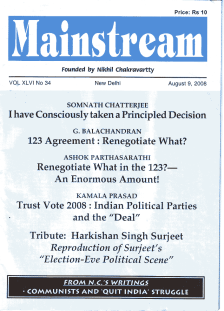 August 9, 2008
Mainstream
– Vol XLVI No 34, New Delhi, August 9, 2008
Somnath Chatterjee
– I have Consciously taken a Principled Decision
G. Balachandran
– 123 Agreements: Renegotiate What?
Ashok Parthasarathi
– Renegotiate What in the 123?—An Enormous Amount!
Kamala Prasad
– Trust Vote 2008 : Indian Political Parties and the “Deal”
Tribute: Harkishan Singh Surjeet
Reproduction of Surjeet’s
– “Election-Eve Political Scene”
Editorial
– Bridging the Divide in J&K
-
 Trust Vote 2008: Indian Political Parties and the "Deal"
10 August 2008, by Kamala Prasad -
China in Africa
10 August 2008, by Purnima RoyChina has been making vigorous efforts to establish a firm foothold in Africa since the beginning of the new century. Prior to the 1990s China had a common policy towards Africa, mainly based on ideology. China was also involved in building railways in countries like Zambia and Tanzania.
The initial interest in China was ideology based. However, this was till the 1990s; thereafter there was no common policy for China. In the latter half of the 1990s the Chinese policy was based on (…) -
Nuclear Deal and Some Strategic Considerations
10 August 2008, by S G VombatkereThe Indo-US nuclear deal (N-deal), called the 123 Agreement, is for cooperation between India and the USA concerning peaceful uses of N-energy. The UPA Government claims that it is meant to ensure India’s energy security through assured sources of uranium supply from the NSG to operate to-be-constructed N-power reactors, by liberating India from the sanctions (“nuclear apartheid”) that were imposed following India’s N-tests, Pokharan I and Pokharan II. It has been noted elsewhere that it was (…)
-
How to Protect the Weakest OBC Communities
10 August 2008, by Bharat DograIn the process of implementing reservations for OBCs (Other Backward Classes) on the basis of the Mandal Commission Report, it has been seen at many places that a few influential and powerful communities manage to corner the benefits, while the weakest communities get almost no benefits. How can we overcome this problem so that reservations can be implemented in a more just way to benefit all deserving communities?
How can we deny undue advantages to some powerful sections while (…) -
Communists and ‘Quit India’ Struggle
10 August 2008, by Nikhil ChakravarttyThis was the week, fiftytwo years ago, that marked the parting of ways between the Communists and the Congress. It was the Communist opposition to the ‘Quit India’ resolution at the historic AICC session in August 1942 that ultimately led to the expulsion of the Communists from the Congress organisations in 1946. Incidentally, the eviction of the Communists from the Congress marked the beginning of the process of transformation of the Congress from an all-embracing national platform to the (…)
-
On a Federal Agency for Metro Terrorism
10 August 2008, by Amna MirzaAs the dastardly fangs of terrorism appear in the bylanes of yet another Metro city, Ahmedabad, it is high time that we sit up and ponder over the dangerous fault-lines.
It needs no iteration that those who believe in killing the innocent lot to prove their prowess so as to terrorise the state apparatus have a very shaky level of conviction in humanity. The threat of terrorism cuts across all borders and the enemy is faceless. The issue of compensation and rehabilitation of affected (…)