 Mainstream Weekly
On September 13, between 1807-1838 hours, five serial bombs shattered a peaceful weekend across several popular market complexes in New Delhi. More than 20 innocent civilians lost their lives in the process and nearly 80 were injured. As was the case in the Jaipur, Bangalore and Ahmedabad bombings of May 13, July 25 and July 26, respectively, an elusive outfit calling itself “Indian Mujahideen” claimed responsibility for the Delhi bombings via an e-mail stating that the atrocities against (…)
Mainstream Weekly ISSN (Mainstream Online) : 2582-7316
Author Submission Guidelines
Mainstream’s Privacy Policy
Donate to Support Mainstream Weekly
Most recent articles
-
Terror Will Not Work
1 October 2008, by Namrata Goswami -
Greater Terror
1 October 2008, by K.B.The Batla House encounter at Jamia Nagar in the Capital has raised a few fundamental questions about Indian democracy, its health and its ability to resolve conflicts on its own.
The most important players in the whole episode are the media and the government. The ‘Other’, in this case the Muslim community, is yet to speak up. But let us accept one truth: the media and the government are on the same side. Muslims are alone, on the other side of the divide.
Like earlier blasts and (…) -
Conversions, Lawlessness and the State
1 October 2008, by S G VombatkereReligious conversion involves change of belief system and habits, and usually change of name. The changes reflect on the ways of living and doing, and in the way the convert interacts with the world around him or her. This is sometimes precisely what is deeply desired by some people for personal reasons. In such circumstances, denying them the right to convert to another way of life and belief would amount to violation of their constitutional right to freedom of religion.
Problems with (…) -
We Need No Taliban Here
1 October 2008, by Nikhil ChakravarttyMaqbool Fida Hussain is at the very centre of a storm whose after-effects are extremely relevant for our democracy—both for the democratic structure of our state and for the preservation of democratic values in our society.
It is not that Hussain is at the centre of a controversy for the first time; in fact, it is seldom he is out of one. He has got thousands of fans, not all because of the beauty of his art but quite a large number applauding him for what would have been called (…) -
Dissecting Anew Hindu-Muslim Ties And Partition
1 October 2008, by Amarendra Nath BanerjeeBOOK REVIEW
HINDU-MUSLIM RELATIONS IN A NEW PERSPECTIVE BY PANCHANAN SAHA (FOREWORD BY DR ASGHAR ALI ENGINEER); BISWABIKSHA, KOLKATA; PP. FORWORD +392; RS 300. Hindu-Muslim relations are very much complicated—the knottiest problem in Indian history. Since the advent of Islam in the Indian subcontinent more than millennium years ago, India faced a powerful challenge from a militant and vigorous religion with an egalitarian appeal. India failed to stem the tide of the rapid spread of Islam (…) -
Education for All : An Introspection
1 October 2008, by Arvind KumarMore than two years ago Krishna Kumar, in an article published in the The Hindu, had fervently argued for our collective responsibility towards children and making a legislation for universal elementary education. Since then the government has gone a long way in enacting a law to this effect and allocating budgetary support for education separately. The government has taken a right step in ensuring universal education upto the age of fourteen years under the programme ‘Education for All’. (…)
-
The Unsung Heroes of 1946
1 October 2008, by Ajeet JawedThe history of our freedom movement is the saga of innumerable armed struggles. One after another, these struggles kept on challenging the British rule in India. However, during and after the Second World War, these struggles acquired a new momentum and new strength. The revolutionary spirit of the Indian National Army had greatly affected the British Indian armed forces. Between March 1942 and the beginning of 1946 there were nineteen uprisings in the Royal Indian Navy alone. The most (…)
-
Why India Became Free
1 October 2008, by Sukumar PathakThe end of the World War II in 1945 also saw the end of the colonial domination of the European nations, especially that of Great Britain overseeing the empire on which the sun never set. The years following 1945 saw a spate of grant of freedom to its dependencies: in 1946, Transjordan from a British protectorate became independent Jordan; in August 1947, India (and Pakistan) became free after 200 years of British rule; Ceylon (now Sri Lanka), a British colony, was free in October 1947; in (…)
-
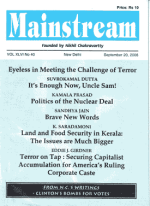
Eyeless in Meeting the Challenge of Terror
23 September 2008, by SCWhile the Wall Street faces a turmoil that impacts on the whole world including India as the media sarcastically dubs the US Administration’s $ 85 billion takeover of the American Insurance Group as the most eloquent manifestation of the transformation of that citadel of capitalism, Washington, into the United States Socialist Republic (USSR), India continues to be shell-shocked by the terror strikes in the Capital last Saturday (September 13), and the principal Opposition party bays for the (…)
-
Crisis of Capitalism
23 September 2008, by Olga TellisThe Wall Street crisis which has seen the mightiest investment banks bite the dust and an insurance giant pleading for time to sets its finances straight seems more like the crisis of capitalism than just the crisis of a few financial institutions.
Barack Obama, the United States presidential hopeful, has blamed it on US President George Bush’s policies but that would be too simplistic. It is capitalism, which feeds on itself, and there is no end to the greed.
The stock market, it is (…)