 Mainstream Weekly
Full Table of Contents - Mainstream, June 27, 2020 LETTER TO THE READERS - COVID 19 Lockdown Edition No.14 Why China’s Finger Points at Ladakh: Imperatives for India | Maj Gen S.G.Vombatkere From the Archives: extracts from the story of Mainstream’s Journey Through The Emergency From The Archives: The Roots of the Emergency | Nikhil Chakravartty [Video: Super Crisis Lies Ahead] | Patrick Bond (9 June 2020) Splintered but not broken: A history of Israel’s independent left | Matan Kaminer and (…)
Mainstream Weekly ISSN (Mainstream Online) : 2582-7316
Author Submission Guidelines
Mainstream’s Privacy Policy
Donate to Support Mainstream Weekly
Most recent articles
-
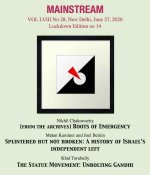
Table of Contents - Lockdown Edition no.14 | June 27, 2020
26 June 2020 -
LETTER TO THE READERS - COVID 19 Lockdown Edition No.14
26 June 2020Letter to Readers Mainstream, 27 June 2020 - Lockdown Edition no 14 Forty-Five years have passed since the midnight of June 25 - 26, 1975, when the infamous National Emergency was imposed on India by Prime Minister Indira Gandhi –- suspending civil liberties, introducing pre-censorship on printed materials, newspapers and publications, and outlawing protest -– marking a big rupture in our political system and damaging our parliamentary democracy. Following the emergency, the anti-congress (…)
-
Why China’s Finger Points at Ladakh: Imperatives for India | Maj Gen S.G.Vombatkere
26 June 2020, by S G VombatkereMao Zedong, first president of the People’s Republic of China, had designs on “reclaiming” territories to the west of China, by placing the “Chinese hand” over the region. Tibet was likened to the palm of the hand, and the fingers were Ladakh, Nepal, Bhutan, Sikkim and NEFA (now Arunachal Pradesh), spanning across the whole Himalayan range.
-
From the Archives: extracts from the story of Mainstream’s Journey Through The Emergency
26 June 2020The story of Mainstream during the nineteen months of Emergency is both exciting and rewarding. It has many lessons to impart. The confrontation with a despotic authority could not possibly be direct and formal: by its very logic it was in the nature of a continuous political guerilla warfare for eighteen long months until its forcible closure with the issue of December 26, 1976. It could reappear only with the relaxation of Emergency following Indira Gandhi’s fateful decision to go to the polls.
-
From The Archives: The Roots of the Emergency | Nikhil Chakravartty
26 June 2020, by Nikhil Chakravartty[Reproduced below is a piece from NC’s Writings first published in Mainstream on July 1, 1995]
As years pass by, one after the other, the past recedes more and more into distant memory. There are certain events in the life of a nation as of individuals, to which distance does not lend enchantment to the view. Rather the ugly visage falls into the pattern of historical evolution and lives on as such. One such event in our lifetime, and in our very land was the Emergency which was (…) -

Video: Super Crisis Lies Ahead - Patrick Bond | 9 June 2020
26 June 2020A conversation with Patrick Bond, professor of political economy at the University of the Western Cape School of Government
-
Splintered but not broken: A history of Israel’s independent left | Matan Kaminer and Joel Beinin
26 June 2020From class struggles to women’s rights to fighting occupation, Israel’s ’independent left’ was never a cohesive social movement. Yet its impact is being felt to this day.
-
The Statue Movement: Unbolting Gandhi | Khal Torabully
26 June 2020It is worth remembering that the movement of statues, beheading Columbus in Boston or throwing the slave trader Colston in Bristol, was preceded by a proposal to unbolt the statue of Gandhi in Ghana in 2018 and the destruction of that of Schoelcher (he voted for the abolition of slavery) in the West Indies. For Gandhi, we are coming back to the charge in the English city of Leicester at this very moment...
-
China, India should keep cooperation as a priority | Ma Bo
26 June 2020It would be a national tragedy for both if they engage in further military conflict at a time when the world needs them to provide global leadership.
-
Does Data on COVID-19 Permit Scientific Studies in India? | Indrakant Sulibhavi, Mahendran Arumugam
26 June 2020Brief Research Paper on COVID-19
by Indrakant Sulibhavi2, Mahendran Arumugam1
Abstract
The paper seeks to examine the suitability of the available data on COVID-19 for studying the spatial variation in transmission of the disease. It looks into the format of the available data in drawing meaningful and useful inferences for policy formulation from the estimates of the parameters. It is observed that in Inter-country analysis some of the statistical and conceptual aspects do not (…)