 Mainstream Weekly
BOOK REVIEW
Farmers’ Suicides—Facts and Possible Policy Interventions by Meeta and Rajivlochan; published by: Yashwantrao Chavan Academy of Development Administration; first published 2006; first reprint 2007; pages 263; price: Rs 495.
One of the most disquieting development in the era of the neo-liberal policy in India has been widespread occurrence of farmers’ suicides in different parts of the country including not only the drought prone areas of Andhra Pradesh, Karnataka and (…)
Mainstream Weekly ISSN (Mainstream Online) : 2582-7316
Author Submission Guidelines
Mainstream’s Privacy Policy
Donate to Support Mainstream Weekly
Most recent articles
-
Indepth Study of Farmers’ Suicides, their Causes and Remedies
25 June 2008, by P R Dubhashi -
Bundelkhand’s Serious Drought Demands Immediate Attention
25 June 2008, by Bharat DograRecently a lot of attention has been drawn to hunger, poverty and five-year long drought situation in Bundelkhand region of Uttar Pradesh and Madhya Pradesh.
Hunger and malnutrition are reaching extreme limits. Cattle and other farm animals suffer from very serious fodder shortage. As I noticed during field-visits from December to May, despite some improvement in government efforts to tackle the serious drought situation, feudal oppression and corruption have combined with ecological (…) -
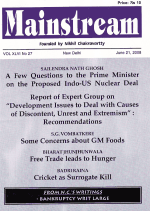
Bankruptcy Writ Large
25 June 2008, by Nikhil ChakravarttyEven if the Finance Minister’s wishes were horses, there is no escape from the economic blizzard that India is about to encounter. Without claiming to be a pundit one can without much difficulty discern from Venkataraman’s Budget oration that our economy is today in doldrums. Leaving aside the inescapable impact of the alarming rise in oil prices, the mismanagement of the economy itself is bound to create serious difficulties.
Six months of the new government has seen no coherent policy (…) -
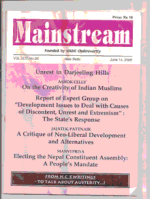
Unrest in Darjeeling Hills
15 June 2008, by SCThe situation in the Darjeeling hills has once again deteriorated with an indefinite strike to project the demand for a separate State of Gorkhaland paralysing life and leaving countless tourists stranded. As we go to press there are signs of further detrioration with the disturbing prospects of ethnic clashes breaking our between activists of the Gorkha Janmulti Morcha on the one side and the Amra Bangali outfits of Bengali chauvinists on the other in Siliguri. In this scenario the (…)
-
To Talk about Austerity…!
15 June 2008, by Nikhil ChakravarttyThe air is thick with talk about the economic crisis facing the country. The Finance Minister has called it “ a grave economic crisis”. “We have not experienced anything similar in the history of independent India,” he has said.
In Parliament, in newspaper offices, in the university campus, in Chambers of Commerce, the talk centres round the urgent need to borrow, to contract loans so that our economy could be sustained and the nation does not collapse under debts.
In other words, our (…) -
Innovative Measures for Inclusive Women’s Reservation
15 June 2008, by Iqbal A AnsariReservation for women in Parliament and Assemblies derives legitimacy from the norms of inclusive democracy, and from the human rights norms requiring institutions to be gender sensitive. But these very norms would also like the Indian legislative bodies to reflect the diversity based on religious and ethnic minorities. Similarly the constitutional promise of social justice to weaker sections requires their political empowerment in terms of their share in legislatures.
The apprehensions (…) -
On the Creativity of Indian Muslims
15 June 2008, by Ashok CellyOne of the most amazing phenomena of our cultural history is the extraordinary creativity of Indian Muslims. They have made outstanding contributions not only to music—something which is generally acknowledged—but also to literature, theatre, films and painting etc. Their contribution is out of all proportion to their demographic presence—a bare 10 per cent of the total Indian population. And this (their enormous contribution) holds true not only of the period before indepen-dence but also (…)
-
The State’s Response
15 June 2008The following is one chapter of the Report of the Expert Group on “Development Issues to Deal with the Causes of Discontent, Unrest and Extremism”, set up by the Planning Commission, in May 2006. With D. Bandyopadhyay, the architect of ‘Operation Barga’ of West Bengal in the eighties and former Secretary, Rural Development, Government of India, as the Chairman, the Group consisted of sixteen members. Besides D. Bandyopadhyay, the other members were S.R. Sankaran, Dr B.D. Sharma, Kamala (…)
-
Capabilities’ Qualifier: Can the Gap be Bridged?
15 June 2008, by Uttam SenThe development of capabilities can liberate people from ancient snares and provide them lives of reasonable dignity and contentment. The ability to lead healthy lives, read and write, form opinions and share them constructively with one’s milieu are the foundations on which the idea of composite well-being has been built. The skills required to draw incomes and nurture livelihoods are integral to the process but their acquisition is not spontaneous and is dependent on a host of (…)
-
West Bengal: Panchayat Election Outcome shakes the Roots of Left Politics
15 June 2008, by Amitava MukherjeeThe results of the just concluded panchayat elections in West Bengal have opened up such possibilities and speculations as has never been witnessed in the 30-year-old Left rule in the State. The reverses suffered by the Left, particularly the CPM, have been so intense that the aftermath has shaken the roots of Left politics in the State. The CPM has been so unnerved that it has decided to go slow on its industrial policy whose principal feature is to please big capitalists at any cost by (…)