 Mainstream Weekly
by Sangeeta Thapliyal
Perception is an essential component of foreign policy. How a country’s government and people perceive the other has a substantial influence in forming its relations with them. Assessing Prime Minister K.P. Oli’s visit to India unfolds certain prevailing perceptions in both India and Nepal.
In Nepal the popular perception is that K.P. Oli is a nationalist who stood up to India during the economic blockade. In fact, this perception was carefully constructed and used (…)
Home > Archives (2006 on) > 2018
2018
-
Oli in India: Changing Perceptions
22 April 2018 -
Promoting Bad Governance Is Bad
22 April 2018, by T J S GeorgeIMPRESSIONS
So it’s mixture as before—Shri Arun Jaitleyis wise, ministers of Southern States are dumb. The South objected to the Centre taking the 2011 population figures as the yardstick for the devolution of tax revenues to the States. Shri Jaitley dismissed the objections in convoluted phraseology. To wit: “Population proxies very well for the needs of the people in quantitative sense. The Income Distance which captures very well relative poverty of people in the States is used to (…) -
The Snake and the Piper: Story of the Oil Prices in India
22 April 2018by Atanu Sengupta and Sanjoy De
Oil is the basic lubricant of the economy. The price of this black liquid gold matters a lot in the lives of the common people in an economy. The tremendous growth of mankind and rapid industrialisation can be attributed to the disco-veries of new oilfields. Quite naturally, the global superpowers are at loggerheads to attain greater command over the sources of this precious commodity. However, since West Asia and the Mediterranean region account for about (…) -
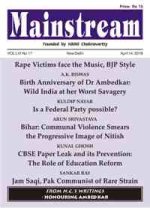 Rape Victims face the Music, BJP Style
14 April 2018, by SCEDITORIAL
In the midst of several major developments across the nation, two horrendous incidents of crime against women—in one case sexual assault on an eight-year-old girl child—in UP and Jammu respectively have rocked the country and shocked the people’s conscience of late. And yet those ruling India today are straining every nerve to obfuscate the crimes if not doing everything to save the accused.
The two incidents are of such a nature that women’s organisations should have been the (…) -
Honouring Ambedkar
14 April 2018, by Nikhil ChakravarttyFrom N.C.’s Writings
Today, April 14, 2018 marks the 127th birth anniversary of Dr Babasaheb Bhimrao Ramji Ambedkar. On this occasion we are reproducing the following piece by N.C. to offer our sincere homage to the abiding memory of that towering personality.
The award of the Bharat Ratna posthumously on B.R. Ambedkar raises mixed feelings. No doubt Ambedkar was one of the stalwarts of modern India; the high water-mark of his career was that he contributed most to the drafting of the (…) -
What is in a name? Highlighting ‘Ramji’ in Ambedkar’s name!
14 April 2018by Ram Puniyani
Currently many Dalit leaders are up in arms and criticising the move of the UP Government of adding ‘Ramji’ in the official records of Bhimrao Ambedkar. It is true that Babasaheb signed the Constitution as Bhimrao Ramji Ambedkar, but as such not too often Ramji is added to his name. The addition may not be challenged technically but it reminds one that this addition is a part of political symbolism, part of co-opting him for Hindutva politics. For the BJP, Lord Ram is the (…) -
Birth Anniversary of Dr Babasaheb B.R. Ambedkar: Wild India at her Worst Savagery
14 April 2018, by A K BiswasPrime Minister Narendra Modi’s impassioned statement on Sunday, August 7, 2016 could have done a sea of good in placing India’s tens of thousands of Dalit and tribal people in a zone marked by high security and dignity: “If you want to attack, attack me, not Dalits.”1 He further resolved about one-and-a-half year ago, as quoted by the media, as saying: “We should put a full stop to it. You can shoot me rather than target the Dalits.”2 Every word uttered in public space by the Prime Minister (…)
-
Dr Ambedkar: A Titan Secularist, Educationist and Social Reformer of Modern India
14 April 2018by Ravindra Sharma
Tentatively, India’s anti-colonial journey (1858-1947) produced five mentors: M.K. Gandhi, Nehru, Ambedkar, Tagore and Bhagat Singh. While Gandhi is still the mentor of Modern India, Nehru is viewed as the architect of “secular and democratic India”. While Tagore is considered as the cultural icon, Bhagat Singh still arouses the passion of the radical youth. However, Dr B. R. Ambedkar (1891-1956) is the most controversial thinker of religion and caste-ridden India. (…) -
Civil Unrest in North India, Snedden’s Advice on J & K
14 April 2018, by Humra QuraishiMUSINGS
If the killings and civil unrest in North India are not halted, anarchy would be spreading out. Going by the recent trends, dissatisfaction of the masses is peaking. Besides the rising numbers of the jobless and hungry, a predominant factor is the failed promises of the political rulers! Not acche din but bure din stares out!
Today there could be hundreds of politicians but leaderless we are! And in this leaderless condition, distractions are no longer holding out. Standing out (…) -
Sociology of Budgeting Education
14 April 2018by Sujit Kumar Choudhary
Budgeting education for the Indian society is more related with the sociological aspect as the Indian society is based on the notion of unity in diversity where everybody has equal rights irrespective of having different castes, religions, languages, regions and genders. The Indian Constitution guarantees the equality of all and provides constitutional safeguards to socially and economically deprived groups of people. It, however, cannot be denied the fact that (…)