 Mainstream Weekly
Science has brought all these mighty changes and not all of them have been for the good of humanity. But the most vital and hopeful of the changes that it has brought about has been the development of the scientific outlook in man. —Jawaharlal Nehru
Nehru’s understanding of science in relation to the country’s development was penetrating. He, unlike some of his senior contemporaries, viewed science with an unbiased and realistic attitude. His belief in the scientific method was unshakable. (…)
Mainstream Weekly ISSN (Mainstream Online) : 2582-7316
Author Submission Guidelines
Mainstream’s Privacy Policy
Donate to Support Mainstream Weekly
Most recent articles
-
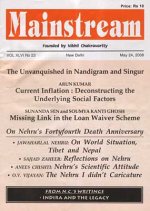
Nehru’s Scientific Attitude
28 May 2008, by Anees Chishti -
The Nehru I didn’t Caricature
28 May 2008, by OV VijayanThere are a dozen or so funny situations I love to fancy Jesus Christ or the Buddha in. Like a sour Centurion (no relation of the columnist) telling Jesus at Calvary, “Look J., don’t be cross!” or the Buddha dozing off under the damned tree, and being shocked into enlightenment by a bird’s dropping. I indulged in these profanities to feel more intimate.
Over the five years or so I’ve been a caricaturist of sorts, the opportunity to be intimate with Nehru had eluded me. I realised to my (…) -
On Nehruvian Humanism
28 May 2008, by K S SubramanianBOOK REVIEW
Jawaharlal Nehru: The Spirit of Humanism by A.P. Saxena; Ane Books India, New Delhi; pp. 165; Rs 395.
The author of this interesting volume is a former civil servant with long years of experience in the management of administration and in the training of civil servants. His experience includes several years in international agencies including the World Bank. He is an unabashed admirer of Jawaharlal Nehru especially with regard to his ideas on the management of the Indian (…) -
Food Crisis and Cooperation on Global Plane
28 May 2008, by Manish SharmaAs the chanting of God’s name removes fear out of one’s mind, repeated calls for globalisation should remove the suspicion of mutual distrust for a positive environment. The basic question at the present moment is to seek an answer of soaring unemployment and fears of hunger and famine on account of shortage of food production in different granaries of the world. Does the positive environment thrown open by expectations of globalisation provide answer to the global pressing problems? The (…)
-
The Universal Didi
28 May 2008, by Devaki JainTRIBUTE
Nirmala Deshpande was Didi not only to those who belong to the Gandhian movement in India, but also to people in Pakistan, ranging from grassroot activists, academics, all the way to the most powerful politicians; and to the people of China who apparently have already instituted a chair in her honour at a university as a tribute, not to mention Nepal and Sri Lanka, and everywhere again sweeping the broad range of actors.
Didi’s particular engagement with peace reveals what one (…) -
Media: Dismal Coverage of Jaipur Blasts
28 May 2008, by Shobhana BoyleThe recent media coverage about the bomb blasts in Jaipur provides a dismal picture of the role that the media has chosen to play on this issue. Extensive visual media coverage focused on drawing conclusions about the motive of the terrorists towards creating religious tension and anarchy in the State. The location of the bomb blasts near the Hanuman temples was highlighted time and again with newspersons interrogating common people and administrative/political personalities on the suspected (…)
-
Gresham’s Law in Present-day India
28 May 2008, by Girish MishraIf one looks at India’s post-independence scenario in political, social, cultural, academic, literary, journalistic, religious or any other sphere, one comes across the phenomenon of the inferior elements pushing out, by and large, the superior competent ones.
To understand the change, let us take, for example, the politics of the Nehruvian days and cite a few representative instances. A Member of Parliament was thrown out by unanimous vote because he had, knowingly, given a false (…) -
CPI-M’s Sleight of Hand delays Justice for Victims of Massacre at Shuchpur
28 May 2008, by Manas GhoshFor the past two years, the reign of terror unleashed by the Government of West Bengal and CPI-M in Singur and Nandigram has drawn headline attention through the length and breadth of the country. However, long before these events unfolded, surreptitious efforts were on to interfere with the course of justice in Suri court (the administrative headquarters of Birbhum district, West Bengal) by the State administration under the directives of the CPI-M, to save from punishment the perpetrators (…)
-
Bravo, Alok Raj!
28 May 2008, by D. BandyopadhyayThe verbal skirmish between Alok Raj, the Deputy Inspector-General, Central Reserve Police Force (CRPF), stationed at Nandigram to maintain law and order, and Lakshman Seth, the Tamluk MP, as reported in the media, not only makes for delectable press copy, but ominously it indicates a far more serious state of disregard for the law and the Constitution that prevails among the CPI-M leaders, cadres, hangers-on and thugs sponsored and supported by the party.
Section 41 of the Criminal (…) -
Fighting Terror—of Different Hues
23 May 2008, by SCThe terrorist blasts in the Pink City of Jaipur on Tuesday, May 13, 2008 have jolted the people at large not just because of the scale of the success achieved by the demented persons indulging in such inhuman criminal activities—80 killed and over 150 injured. The entry of Jaipur into the terror map of the country (it was out of that map so far) is indicative of the increasing spread of terrorism despite all the vigilance by the security and intelligence forces across the nation. The growing (…)