 Mainstream Weekly
In India when the participation rate of the female labour force rises, it is often seen as a positive sign of progress and inclusion. The Periodic Labour Force Survey (PLFS), reported an increase in rate from 23.3% in 2017–18 to about 41.7% in 2023–24, which is indeed a big improvement. However, these figures may not be 100 percent accurate. A large part of this rise is due to women working in family businesses or farms where they are not paid rather than in paid or formal jobs. Many women are considered as “employed” even though they do not earn wages. However the report is also noted that, females perform 2/.6 times more unpaid care giving/domestic work, even when they are otherwise contributing economically.
This depicts a major issue in how employment is measured. Just because a woman is working does then also we can"t say she is financially independent or empowered. For example, women helping in farming or household work may work long hours but still have no financial control or personal income. So, being counted as employed does not always mean true economic freedom. (Chandrasekhar, C. P., & Ghosh, J. (2024, January 9)). In recent years, the discourse surrounding women’s unpaid labour in India has gained greater public attention through digital media, policy debates and gender studies. Nobody talks about the real cost of motherhood in India as not just an emotional and social responsibility, but also an economic burden that is largely invisible in labour statistics. Women often sacrifice education, paid work, career development and financial opportunities to perform care work in households. This work is essential for the family’s survival and for social reproduction, but it is unpaid and undervalued. (Brut India. (2026).)
India’s Time Use Survey (2019) found that women spend nearly 299 minutes per day on unpaid domestic services, whereas men spend only 97 minutes, making it one of the largest gender divides in unpaid care work among the world’s economies. Other studies estimate that the economic value of women’s unpaid care and domestic labour ranges from 11% to 27% of India’s GDP, but this contribution is not factored into national income calculations. (The Economic Times, 2023)
This issue is even more relevant when viewed in the light of recent government policies and labour market reforms that celebrate the rising female labour force participation without probing into the quality of women’s employment. This becomes an even more pertinent issue in the context of recent government policies.
Government schemes promoting women’s self-help groups, rural employment, financial inclusion, and entrepreneurship have increased women’s visibility in economic activities. But many women continue to be concentrated in unpaid family labour, informal agriculture and care work. Consequently, statistical gains in employment often fail to translate into genuine economic empowerment, wage security, ownership or financial independence for women.
The “real cost of motherhood” and unpaid care work is therefore not only emotional or social, but also deeply economic. It reflects the invisible foundation upon which households, labour markets, and the Indian economy continue to depend, even as women’s contributions remain largely ignored in policy measurement and public recognition. (Janiso, A., Shukla, P. K., & Reddy, B. A. (2021).)
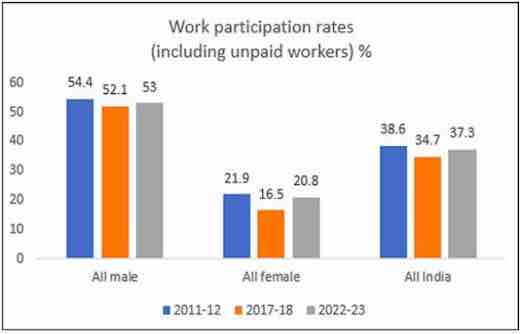
The Growth of Unpaid Family Labour Among Women:
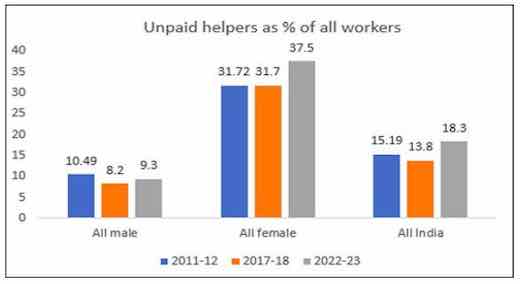
The increase in female labour participation in India is closely related to the growth of unpaid family work. Recent labour studies have pointed out that women are increasingly concentrated in self-employment and household enterprises, rather than regular salaried jobs. A study based on the PLFS data has shown that the share of women in self-employment increased from 53.4 per cent in 2018-19 to 65.3 per cent in 2022-23. More worrying is the increase in the share of unpaid family labour for women, which went up from 30.8% to 37.5% in the same period. (ResearchGate. (2024))
This means that more than one-third of working women in India are in labour for which they are not paid directly. The situation is worse still in rural areas. Almost half of all rural working women are engaged in unpaid family work in relation to agriculture or household enterprises. Women are being moved more and more out of unpaid domestic work and into unpaid economic work, so that they can be counted as employed in labour statistics without any great improvement in their financial situation. (The Print. (2024))
Economists refer to this as a sign of distress, not empowerment. With the increase in inflation, fluctuating income from agriculture and diminishing household resources, women have made greater economic contributions towards the survival of the family. But women are being drawn into low-paid or unpaid activities that remain economically invisible rather than drawn into the secure employment sectors.
Agriculture and the Feminisation of Survival Work:
A big development in the labour market in India is the increasing concentration of women in agriculture. In most developing economies, economic growth usually involves a movement of labour out of agriculture and into manufacturing and services. But for women in India, the opposite is happening. The share of rural women working in agriculture increased from 71.1% in 2018-19 to 76.9% in 2023-24.
This pattern is what many economists call “reverse structural transformation.” Alternative employment opportunities are still not accessible, and women are therefore returning to agriculture instead of moving into higher productivity sectors. Often rural women work in sowing, harvesting, livestock management, dairy production and post-harvest activities without wages because they are not considered as economic employment but they are considered as part of family responsibility. (ILOSTAT. (2026))
The number of women working in agriculture increases mainly because men are moving to cities in search of jobs, and better salaries and rural areas are facing economic problems. When men migrate to cities, the responsibilities of women increase in taking care of farming and managing the agricultural work on their own. However, even though they do most of the work, they usually do not own the land,have little control over the money earned, and find it difficult to get loans from banks or other institutions. (Institute for Human Development (IHD))
Women play a very important role in farming and help keep the rural economy running, but they are still not financially independent . Their work is often not properly recognised because it is unpaid and part of the informal sector, so its value is not fully understood or appreciated.
The Invisible Burden of Unpaid Domestic and Care Work:
Women’s economic invisibility is by no means confined to agriculture. Indian women also do huge amounts of unpaid domestic and care work daily. Much of the day is spent on activities such as cooking, cleaning, childcare, eldercare, collecting water, gathering fuel and managing households, which are seldom acknowledged as economic input.
Based on data from India’s Time Use Survey, we find that traditional labour statistics cover almost 75% of work by men but only about 33% of work by women. The majority of unpaid domestic work performed by women is excluded from GDP calculations and employment categories. (UN Women. Economic empowerment)
Research in India consistently states that women devote more time to household chores and caregiving than men no matter their income level or social background. Because of this, many women face what economists call the “double burden”, they are expected to handle both unpaid work at home and, at the same time, contribute to earning an income. ( ScienceDirect. (2017))
This kind of unpaid work is not just tiring; it also limits women’s opportunities. When a large part of their day goes into managing the home and taking care of others, they are left with very little time or energy for studying, learning new skills, traveling for work, or taking up jobs. Over time, this becomes a bigger concern as it hampers the growth of women in their career or finding better economic opportunities. (HealthBridge Foundation of Canada. (2009))
Ironically, the Indian economy is highly reliant upon such forms of invisible labor. Families, farms, and communities would not function were it not for the unpaid contributions that women make towards providing care and other forms of support that would require large government spending if performed by others. Since such work is unpaid, however, it does not get recognized in any statistics, remaining invisible in its social value.
Employment Without Financial Independence:
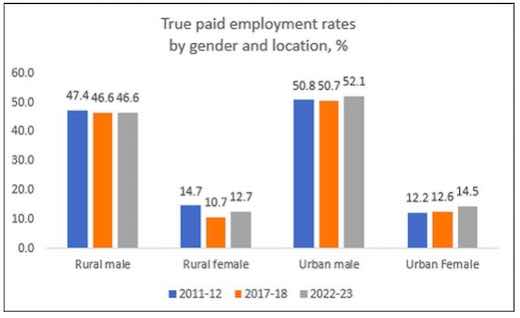
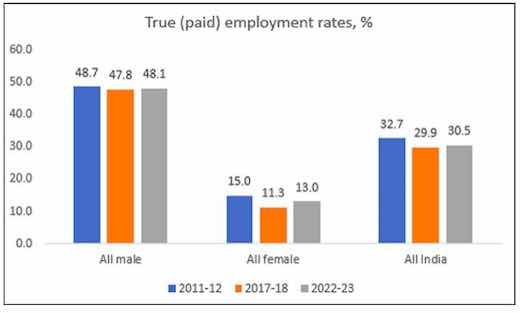
Being classified as employed, women often remain economically dependent despite the significant amount of work they perform in their households. Thus, despite having to work hard, such women may have no personal incomes, savings, nor any ownership rights. This form of employment thus makes women economically dependent in an invisible manner. (IJPSL. (2022))
It has been estimated that women’s contribution to the economy through unpaid care work is substantial for the national economy as well. According to the Economic Survey 2024, the percentage of care work’s contribution to the GDP of India amounts to 3.1%. The women providing this type of work, however, do not have any social protection or even healthcare security. (International Association for Research in Income and Wealth. (2021))
In addition, the lack of income influences women’s negotiating power within their households. Economic dependency constrains their autonomy in matters pertaining to education, health, movement, and family spending. In most rural households, women play an important role in production but are not accorded property rights. (National Institutes of Health (NIH). (2007))
Why Does Labour Statistics Need to Change?
In today’s India, the measurement of labor force participation is still heavily dependent on the definition of employment which sometimes fails to differentiate between productive employment, non-productive employment, and survival activities. It is feared that unofficial statistics might show an increase in employment which might simply mean an increase in people involved in any kind of unpaid economic activity.
In this way, the situation is very tricky as it shows a positive trend when in reality nothing has changed in the economic standing of such workers. This becomes more alarming when it comes to increased participation of women, as this number might just reflect the reality that most of the employment created for women is of unpaid nature. (The India Forum. (2025))
It is now increasingly argued by experts that the importance of quality of employment should be emphasized. The issues of income levels, job security, ownership, working conditions, and access to social protection play important roles in assessing women’s economic status.
As long as these factors remain outside the labor statistics, many women who are employed but lack these elements of empowerment will remain economically invisible. (Harvard Kennedy School. (2017))
Conclusion:
Indian workforce statistical information is not a good trend but a perfect trend. The thing is, a lot of women are seen as workers, but they don’t make money or get any recognition, and they stay financially dependent on other people. So, while the increase in the women’s representation among workers in India is a step forward, the numbers need to be looked into with more scrutiny because it doesn’t matter if the presence of women in the workforce doesn’t mean their wage payment, financial stability and social appreciation of their role.
Empowerment cannot be confined to acceptance of women as workers, but it means social respect, payment of wages, job opportunities, less caretaking responsibility and an economic environment in which these women flourish as self-reliant, economically independent and empowered individuals.
(Authors
Deepa Palathingal, Ph.D., Fellow at Centre for Studies in Population and Development (CSPD), Assistant Professor in Economics, Christ Deemed to be University, Delhi NCR
Palak Kunwar, Intern at Centre for Studies in Population and Development (CSPD), Economics and Mathematics Honours student, Christ Deemed to be University, Delhi NCR )
References
[1] Chandrasekhar, C. P., & Ghosh, J. (2024). The unpaid workers who are described as “employed”. IDEAs – International Development Economics Associates. https://www.networkideas.org/2024/01/09/the-unpaid-workers-who-are-described-as-employed
[2] UN Women. Economic empowerment: Facts and figures. United Nations Women. https://www.unwomen.org/en/what-we-do/economic-empowerment/facts-and-figures
[3] The Print. (2024). Women are moving from unpaid family work to self-employment — why that’s not enough. https://theprint.in/opinion/women-are-moving-from-unpaid-family-work-to-self-employment-why-thats-not-enough/2905921/
[4] HealthBridge Foundation of Canada. (2009). Economic and social analysis of female unpaid labour report. https://healthbridge.ca/dist/library/HB-_ESAF_ER.pdf
[5] Institute for Human Development (IHD). Women, unpaid labour and employment trends in India. https://www.ihdindia.org/pdf/Att2.pdf
[6] National Institutes of Health (NIH). (2007). Research on unpaid labour, women’s wellbeing and economic inequality. https://share.google/m0lQ7Kji8pZ77PmFS
[7] ScienceDirect. (2017). Gender gap in unpaid care work and labour burden studies. https://share.google/DK3hCr01kLgrFJI6U
[8] International Association for Research in Income and Wealth. (2021). Economic valuation of unpaid work and household labour. https://share.google/y6QZcQHU26Sh38aKR
[9] ResearchGate. (2024). Decoding rising female labour force participation in India: Evidence from PLFS data. https://share.google/19AN2WpRSrq2HUlPO
[10] Harvard Kennedy School. (2017). Women’s work, labour measurement and economic inclusion. https://share.google/cxfQstE4Ou7VuKzXK
[11] ILOSTAT. (2026). Female labour force participation and informal employment statistics. International Labour Organization. https://share.google/UwGGSJudyWQ4hIk2Q
[12] The India Forum. (2025). Invisible labour and women’s employment in India. https://share.google/rnK4lhDkFAkyrFvZd
[13] IJPSL. (2022). Legal and socio-economic dimensions of unpaid women workers.
https://share.google/Thhhd7xJHEw1xIgty
[14] Ghosh, J. (2021). The interlinkages between paid and unpaid labour: A homage to Krishna Bharadwaj. The Indian Economic Journal, 69(2), 338–351. https://doi.org/10.1177/0019466221101983
[15] Brut India. (2026). The real cost of motherhood in India nobody talks about. https://www.brut.media/in/articles/india/society/the-real-cost-of-motherhood-in-india-nobody-talks-about
[16] The Economic Times. (2023). Centre weighs methods to quantify household chores done by women. https://m.economictimes.com/news/india/centre-weighs-methods-to-quantify-household-chores-done-by-women/articleshow/99917219.cms
[17] Janiso, A., Shukla, P. K., & Reddy, B. A. (2021). What explains gender gap in unpaid household and care work in India? https://arxiv.org/abs/2106.15376