 Mainstream Weekly
The Union Finance Commission is a constitutional body established under Article 280 of the Indian Constitution. Its primary task is to recommend the distribution of net proceeds of taxes between the Union and the states, and also to suggest measures to enhance the fiscal health of states. Over time, the criteria used by successive Commissions have shifted in response to economic developments, national priorities, and the need to ensure both equity and efficiency in resource allocation. The Union Finance Commission has always facilitated the implementation of national aspirations in action. While the criteria are revised with every UFC, they also subtly hint at the governmental philosophy, agenda and strategy. The most recent stage in the evolution of these criteria laid out is the ‘Contribution to GDP’ by the 16th Finance Commission. This article examines this new criterion, places it in the historical context, and analyses what it reveals about India’s recent focus on economic growth.
In the early Finance Commissions, the emphasis was on easily measurable demographic and fiscal factors. For example, the 8th Finance Commission, covering the period 1985 to 1990, used population based on the 1971 Census as a major criterion. It also included measures such as Per Capita Income Distance, and Inverse Income to address disparities. Over time, the scope expanded to include area, index of infrastructure, tax effort, and fiscal discipline. By the 14th and 15th Commissions, there was increased attention to social indicators, forest cover, demographic performance, and fiscal discipline. These reflected the broader development goals of the nation and the need to balance equity with incentives for good governance. Despite these adaptations, until the 16th Finance Commission, no explicit criterion rewarded states for their contribution to national GDP. The focus remained largely on leveling disparities and accommodating demographic and developmental needs.
The 16th Finance Commission, under the chairmanship of Dr. Aravind Panagariya, has made a clear change from earlier practice by adding ‘Contribution to GDP’ as a criterion for distributing states’ shares from the divisible pool. Under this criterion, a state’s share is calculated using the square root of its Gross State Domestic Product (GSDP), divided by the sum of the square roots of the GSDP of all states. The Commission measures GSDP as the average of nominal GSDP from 2018–19 to 2023–24, while excluding 2020–21 to avoid distortions caused by the Covid-19 pandemic.
The basic principle is that states contributing more to national output should receive a larger share of the divisible pool. This shift carries several important implications.
The ‘Technical Note of Calculation’ of this criterion as per the official report of the Commission is given as:
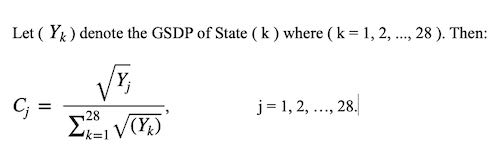
The criterion is calculated as the share of square root of the state’s GSDP in the total of the square roots of the GSDPs of all 28 states.
According to the report, the GSDP of each state is calculated as the average of nominal GSDP of the state from 2018-19 to 2023-24, excluding 2020-21 (COVID-19 year).
The introduction of the GDP criterion reflects a broader shift in India’s policy environment towards growth. Over the last decade, India has pursued strategies aimed at higher economic expansion, industrial development, and improved productivity. Initiatives such as Make in India, production-linked incentive schemes, infrastructure development, and reforms in labour and land markets underscore the centrality of growth in policy discourse. Given this national focus, the Finance Commission’s inclusion of contribution to GDP is not merely technical. It suggests a shift away from purely needs-based allocation towards a hybrid model that balances equity with incentives for performance. It is a normative judgement that growth and output creation should be rewarded in resource transfers. The logic is that states which help drive the national economy deserve recognition and support for sustaining and enhancing growth.
Since the early 2000s, India’s economic policy has increasingly focused on growth as the main driver of development. After liberalisation in 1991, the economy expanded rapidly, reducing poverty and leading to the growth of a large middle class. This emphasis on growth became stronger after the global financial crisis of 2008, as India continued to record relatively high economic growth rates. More recently, despite the disruptions caused by the COVID-19 pandemic, India’s economy has remained resilient and has emerged as one of the fastest-growing large economies in the world.
This emphasis on growth is reflected not only in macroeconomic policy but also in political debate and policy decisions. Economic growth is often presented as the basis for job creation, poverty reduction, and the fiscal capacity required to fund social welfare programmes. International institutions such as the World Bank, the International Monetary Fund, and the Organisation for Economic Co-operation and Development also stress the importance of growth for development. In this context, the Finance Commission’s decision to include contribution to GDP aligns with the broader direction of India’s economic policy. While linking fiscal transfers to contribution to GDP supports the growth agenda, it also raises concerns about equity and fiscal fairness. Indian states differ widely in population size, levels of development, industrial capacity, and ability to generate output. Less developed states may find it harder to increase their GDP quickly compared to more advanced states. If higher GDP contribution leads to larger transfers, poorer states risk having reduced fiscal space.
Earlier Finance Commissions tried to balance this tension between equity and efficiency by using criteria such as population, income levels, poverty ratios, and infrastructure gaps to support disadvantaged states. The inclusion of the ‘Contribution to GDP’ shifts the balance towards rewarding economic performance, making it necessary to carefully assign weights so that existing regional inequalities are not strengthened.
This concern can be examined through the lens of Amartya Sen’s capability approach, which challenges the identification of development solely with economic output. Sen argues that development should be understood as the expansion of substantive freedoms , including access to education, healthcare, nutrition, and social opportunities. If fiscal transfers are tied more closely to GDP contribution, states may prioritise output-enhancing investments over long-term human development expenditures. Poorer states, which often face deficits in health and education indicators, may require greater fiscal support precisely to expand capabilities. A formula that overemphasises GDP risks shifting attention away from capability equalisation, thereby narrowing the broader developmental vision.
The 16th Finance Commission was formed during a period of economic uncertainty following the Covid-19 pandemic, global disruptions, and changing development priorities such as infrastructure expansion, digitalisation, and manufacturing growth. By excluding the pandemic year while calculating average GSDP, the Commission aimed to measure economic performance more accurately. The evolution of fiscal criteria thus reflects not merely administrative reform but a deeper philosophical shift, from a capability-equalising model of federal transfers toward a productivity-rewarding framework. The long-term sustainability of this shift will depend on whether growth-led incentives can coexist with the constitutional commitment to reducing regional disparities.
(Authors: 1. Shubhalaxmi Jaydeep Sagare, III Year Student, BSc Economics and Analytics,, CHRIST (Deemed to be University), Lavasa, Research interests: Development Economics, Gender Economics, Public Finance
2. Dr Tiny S. Palathara, Assistant Professor and Program Coordinator of Economics
CHRIST (Deemed to be University), Lavasa, Research interests: Development Economics, Behavioral Economics, Gender Economics and Public Policy )
References
Official Report of the Sixteenth Union Finance Commission: https://fincomindia.nic.in/commission-reports-sixteenth