 Mainstream Weekly
Kazi Nazrul Islam, the revered poet of Bengalis around the globe must be sulking in his grave at the disregard and insult meted out to his famous poem
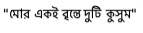
" (Mora eki brinte duti kusum), meaning "two blooms on one stem" by the BJP Bengali leaders, who see Gujarati duo, Narendra Modi and Amit Shah as the precursor of a communally exclusive new future for West Bengal
Nazrul’s poem is used as a powerful expression of unity, particularly to emphasize the shared existence and harmony between Hindus and Muslims. The verse highlights that despite different identities, both communities share the same motherland, air, and water, essentially growing from the same source. But what has been most unfortunate is Modi for promoting the business interest of his friends, has been out to tear the two blooms apart.
This is the basic difference between the two cultures. If Gujarati culture has been basically of inclusive nature, Gujarati duo must have refrained from dividing the Muslims and Hindus. An insight into the Gujarati culture would make it explicit that it has significantly different from Bengali. The "culture" of Gujarat can be defined as an authoritarian populist culture of "corporate Hindutva", characterized by a fusion of neoliberal economic policies that benefit big capital and an aggressive form of Hindu nationalism (Hindutva) that deepens social and religious polarisation.
Modi’s "Gujarat Model" of development is seen not as a general success for all, but as a system built on granting significant subsidies and benefits to large industrial corporations (e.g., the Adani Group) at the expense of social welfare spending on health and education. This has led to "jobless growth" and the increased informalization of labour, resulting in precarious conditions and stagnant wages for the working class.
Violent Hindu nationalism is an essential, underlying component of this culture. This "culture" involves the de-institutionalization of the rule of law and the suppression of dissent, creating a "deeper state" where Hindu nationalist ideology penetrates societal institutions. This top-down, centralized governance structure ensures that the interests of the ruling class and the Hindu nationalist agenda are maintained. This culture is not defined by its traditional heritage, instead as a contemporary "laboratory" for a national strategy that uses an ideological mix of "development talk" and religious majoritarianism to facilitate capital accumulation for the few, while marginalizing large segments of the population.
Marxist theory posits that culture is not an abstract, independent sphere but a "superstructure" determined by the "base" of economic production and class relations. Bengali culture, therefore, is viewed as a reflection of the evolving agrarian and industrial systems, land ownership patterns, and class conflicts throughout its history. In Bengal, the link between culture and politics has historically been very strong, with a large section of the intelligentsia leaning heavily towards Marxist ideology. Cultural activities are not merely private or individual pursuits but have an "interventionist" purpose, aimed at transforming society. This is evident in the work of the Indian People’s Theatre Association (IPTA) and various Bengali periodicals that sought a "concrete analysis of concrete situations" across society, economics, and art.
Karl Marx saw culture as part of the superstructure, which arises from and reflects the economic base (infrastructure), consisting of forces and relations of production, with political/legal institutions (structure) mediating between them, meaning the ruling class’s economic interests shape cultural values, laws, and ideas to maintain their power, though this relationship is complex and reciprocal. Behind of the fa