 Mainstream Weekly
INDIA OCCUPIES A strategic position in the global workforce market due to its skilled workforce, and an expanding consumer market. India’s growth underpins GDP growth performance in Southern Asia, ‘a sub-region whose GDP is said to have grown by 6.2 per cent in 2024 and by 5.8 per cent in 2025’. Worldwide, over 61.20 per cent of employment, more than 2 billion people, is in the informal economy (ILO, 2018).
The majority of India’s workforce operates within the informal sector, where the benefits usually associated with formal employment are largely lacking. The term ‘labour market’ can refer to various geographical areas, occupational and industrial sectors, and groups of workers defined by ethnicity, race, gender, education, and skill levels (Kalleberg and Sørensen, 1979).
In the field of labour economics, multiple markets exist, and the Daily Labour Market (DLM) is one of them; it is a significant segment where a substantial proportion of workers engage in informal activities. India, considering the existence of notable gender imbalances, has a powerful presence in DLM, with extreme pay gaps for women and limited access to secure, good-quality jobs that provide full-time income (Ara, 2015).
Drivers of India’s Workforce
In the context of daily informal labour, key drivers such as poverty, limited job options, skill shortages, irregular income, unemployment, family issues, and debt compel Indian workers to engage in the labour market, despite the physical hardships. For effective policymaking, it is crucial to focus on creating jobs, ensuring prompt and equitable payments, keeping living costs affordable, enhancing workplace safety, and safeguarding workers’ rights and social security.
The Periodic Labour Force Survey (PLFS) reports from 2022 to 2025 indicate that the labour force participation rate (LFPR) for individuals aged 15 and above has varied from around 58.5 per cent to 62.8 per cent in rural areas, and from 50 per cent to 52.2 per cent in urban areas. In 2022, the LFPR for persons aged 15 years or older was 56.1 per cent, increasing to 59.3 per cent in 2025. In 2022, the Worker Population Ratio (WPR) was 37.9 per cent, rising to 43.5 per cent in 2025.
For urban men, WPR rose from 55.0 per cent in 2022 to 57.2 per cent in 2025, and in rural areas, it rose from 53.6 per cent to 57.2 per cent.
Among urban women, WPR increased from 18.1 per cent in 2022 to 20.7 per cent in 2025, while in rural areas, it grew from 26.9 per cent to 33.8 per cent in the same period.
The rise in the worker-population ratio suggests that more people are working, including in informal jobs where concerns about daily wage labour are especially important.
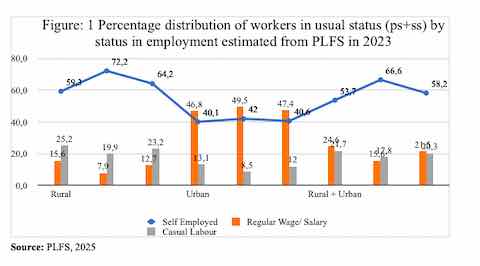
According to PLFS 2023, in rural India, a significant portion of the workforce is self-employed: 59.3 per cent of men and 72.2 per cent of women. Conversely, only 15.6 per cent of men and 7.9 per cent of women work in regular wage or salary jobs. In urban areas, the share of regular wage/salary employment is higher, 46.8 per cent for men and 49.5 per cent for women, although self-employment remains notable.
In India, workers involved in DLM are more exposed to economic instability because they often cannot fully access healthcare or social protections, particularly in vulnerable groups.
Source: PLFS, 2025
Figure 1 depicts that 58.2 per cent of all workers in India are self-employed, with 21.5 per cent in regular wage or salaried positions, and 20.3 per cent engaged in casual labour.
This highlights a predominantly informal, insecure, and gender-unequal labour market, where women are more likely to be confined to low-security self-employment and casual work rather than stable employment (Mitra, 2005).
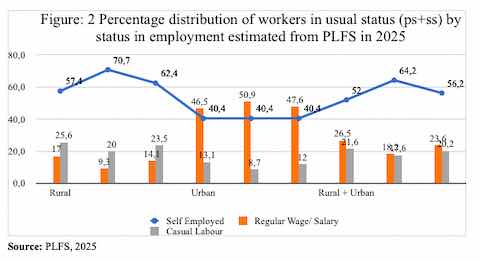
Based on the 2025 PLFS data, self-employment remains the primary form of work for all groups, particularly among women and in rural areas. In rural India, 57.4 per cent of men and 70.7 per cent of women are self-employed, compared to just 17.0 per cent and 9.3 per cent who work in regular wage or salaried jobs.
Source: PLFS, 2025
Figure 2: Urban areas show a higher share of regular wage earners (46.5 per cent for men and 50.9 per cent for women), yet self-employment remains significant. Overall, 56.2 per cent of workers are self-employed, 23.6 per cent earn wages or salaries, and 20.2 per cent are casual labourers. This pattern highlights a largely informal, insecure, and male-dominated labour market, with women more often engaged in low-security self-employment and casual labour than in stable wage jobs.
Source: PLFS, 2025
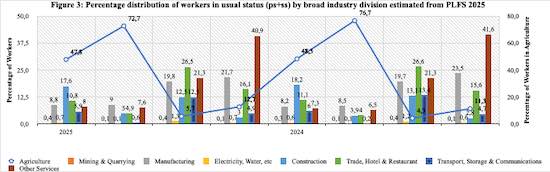
Figure 3 illustrates that 72.7 per cent women were working in agriculture in 2025 and 76.7 per cent in 2024, compared with only 47.8 per cent and 48.3 per cent among rural men. This is data according to the Ministry of Statistics and Programme Implementation (MoSPI) and the National Statistics Office (NSO). The Ministry of Statistics and Programme Implementation Quarterly Report, 72.7% (or up to 73.5% in specific quarterly metrics) of rural female self-employed workers and 72.7% of all rural female workers were engaged in agriculture.
In contrast, urban workers primarily engage in trade, hotels & restaurants, and other services, with women representing a significant share, especially in ‘other services’, where urban women account for 40.9 per cent in 2025 and 41.6 per cent in 2024. In both years, rural men mainly work in construction (17.6–18.2 per cent) and manufacturing (8.2–8.8 per cent), while urban women are predominantly involved in informal service jobs with low job security.
Overall, the data emphasise a persistent rural–urban gender-based sectoral divide: rural women are mainly engaged in agriculture, whereas urban women tend to be confined to low-protection service and trade roles, with limited participation in higher-security sectors such as electricity, construction, mining, or transport. Many daily-wage workers in these sectors face challenges such as unpredictable work availability, the urgent need to work, low wages, and limited access to benefits like comprehensive medical coverage, a basic pension, and affordable housing.
Source: PLFS, 2025
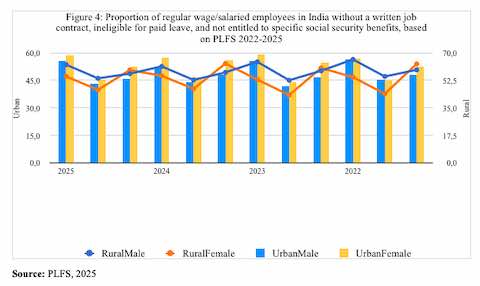
Figure 4 illustrates that from 2022 to 2025, over 60 per cent of rural regular workers, both men and women, lacked written employment contracts, while the proportion in urban areas was slightly lower but still exceeded 50–55 per cent.
Most also did not receive paid leave or social security benefits: in rural India, 55–59 per cent of men and 59–63 per cent of women had no social security coverage, compared to 45–48 per cent of urban men and 52–56 per cent of urban women.
Women in regular employment face greater risks of lacking contracts and social benefits than men, especially in rural regions.
Source: PLFS, 2025
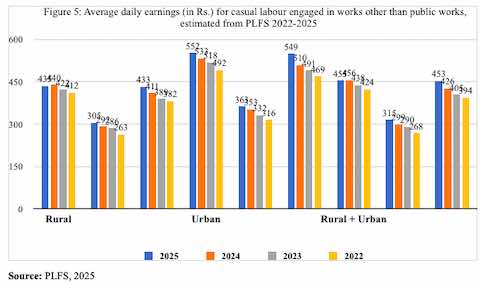
Avarage Earnings, Figure 5
Indian daily workers often do not earn enough per day, which impacts their socio-economic status and health. For instance, casual labourers’ average daily earnings (excluding public works) grew modestly from 2022 to 2025, with urban wages significantly higher than rural wages and persistent gender disparities favouring males.
The national average per person increased from ₹394 in 2022 to ₹453 in 2025, driven mainly by urban areas where wages rose from ₹469 to ₹549. Rural earnings grew more slowly, from ₹382 to ₹433, resulting in a widening urban–rural gap in absolute terms. Male casual labourers consistently earned more than females across all regions: in 2025, rural males earned ₹435 compared to ₹ 305 for rural females, while urban males earned ₹552 compared to ₹363 for urban females, highlighting a notable gender pay gap, especially in urban settings.
Policy Implications
The practical implementation of the new labour codes (2020) could significantly shape the dynamics of the Indian labour market, especially in the informal sector. The new codes ‘aim to modernise India’s labour regulations to attract policy attention’. They aims to potentially foster a more balanced and regulated system. However the last six years of implementation has yet to show a major shift in the ground reality. Using the Current Weekly Status or CWS for ages 15 and above, the MoSPI latest PLFS (September 2026) Highlights show:
- Labour Force Participation Rate (LFPR): Overall LFPR stood at 55.5% (Rural: 58.0%, Urban: 50.7%).
- Female LFPR: Reached 34.6%.
- Worker Population Ratio (WPR): Overall WPR was 52.7% (Rural: 55.5%, Urban: 47.2%).
- Unemployment Rate (UR): Overall unemployment rate remained steady at 5.0% (Rural: 4.2%, Urban: 6.9%).
What this means is that, if PLFs are the criteria, only a little more than half the people in a nation of 1.4 billon people work and there is a huge chunk of uncounted labour; raising doubts about the actual unemployment figures.
It is evident, to empower India’s informal sectors where the lack of contracted jobs, irregular wages, long working hours, lack of medical coverage and a lack of institutional benefits, especially after retirement, some key issues need immediate attention. They are summarised below:
Recognition and registration of daily DLM workers, particularly women, are essential. This helps improve occupational safety and health, as well as access to affordable housing and infrastructure. Strengthening work institutions is crucial to offer adequate protection for DLMs.
Institutional collaboration is necessary to adapt policies effectively and assess their practical impact on DLMs.
(Author: Yatish Kumar is an Assistant Professor at the Indian Social Institute, New Delhi, India. Email ID yatishsocialinstitute2024[at]gmail.com)
References
- Ara, S. (2015). Gender and jobs: Evidence from urban labour market in India. The Indian Journal of Labour Economics, 58(3), 377–403. https://doi.org/10.1007/s41027-016-0027-2
- Government of India. (2026). Periodic Labour Force Survey (PLFS) annual report 2025. Ministry of Statistics & Programme Implementation.
- International Labour Organisation. (2018). Women and men in the informal economy: A statistical picture. ILO.
- Kalleberg, A. L., & Sørensen, A. B. (1979). The sociology of labor markets. Annual Review of Sociology, 5, 351–379. https://doi.org/10.1146/annurev.so.05.080179.002031
- Mitra, A. (2005). Women in the urban informal sector: Perpetuation of meagre earnings. Development and change, 36(2), 291–316. https://doi.org/10.1111/j.0012-155X.2005.00412.x
- The Hindu Bureau. (2025, January 16). Global labour market recovery is slow, India an exception: ILO report. The Hindu. https://www.thehindu.com/news/national/global-labour-market-recovery-slow-india-an-exception-ilo-report/article69105663.ece