 Mainstream Weekly
Abstract
In the last decade and a half, public debt has surged globally, and the World Bank classifies it not as a debt wave but rather a “tsunami”. This article attempts to underscore the importance of a country’s formal and particularly quality of informal institution in shaping its sovereign debt. Our results reveal that countries with better-quality formal institutions need not necessarily manage debt well, but stronger informal institutions, in the form of social trust, are of pivotal importance. Our analysis highlights that if debt must be controlled, fiscal policies by formal institutions should adhere to the informal constraints set by society.
1. Motivation
The June 2026 edition of the World Bank’s Global Economic Prospects underscores mounting concern about rising sovereign debt levels and higher borrowing costs, which have posed significant challenges for many economies over the last decade and a half. Public debt has been traditionally viewed as through the lens of fiscal mismanagement, economic development and governance. Governments are expected to manage debt levels but the persistence high level of debt has raised a concern of whether formal rules alone can control public debt levels.
Data released by the IMF World Economic Outlook (2025) reveals that in 2024 nominal public debt had doubled in value from what it was in 2010. Kose et al. (2021) term this phenomenon of debt accumulation as the fourth wave of debt. The authors describe this wave of debt as the “Largest, fastest, and most broad-based wave yet”. In fact, considering 2010 as the base year, developing countries have witnessed a larger rise in public debt than developed countries; see Fig. 1. More importantly, the majority of developing nations are above the Maastricht Convergence Criteria of a 60 per cent Debt-to-GDP ratio; see Fig. 2. The debt crisis that started post-global financial crisis got further impetus from the pandemic of 2020. Stricter monetary measures across the globe to curb inflation translated to higher borrowing costs, causing greater fiscal pressure on governments. Data from the World Economic Outlook, IMF reveals that by 2024, the average interest payment as a percentage of GDP for developing countries crossed the 2% mark, while for the developed countries it stayed below 1.5%. Over the last decade and a half, interest payments consume a higher share in government revenue in developing economies (8.5%) than in developed economies (3.5%). The ongoing geopolitical tension in West Asia raises energy costs, along with slower economic growth. These are likely to exacerbate fiscal pressures, potentially leading to further increases in sovereign debt levels.
Fig. 1: Growth in Nominal Public Debt Across Developed and Developing Countries
Data Source: World Economic Outlook, IMF (2025)
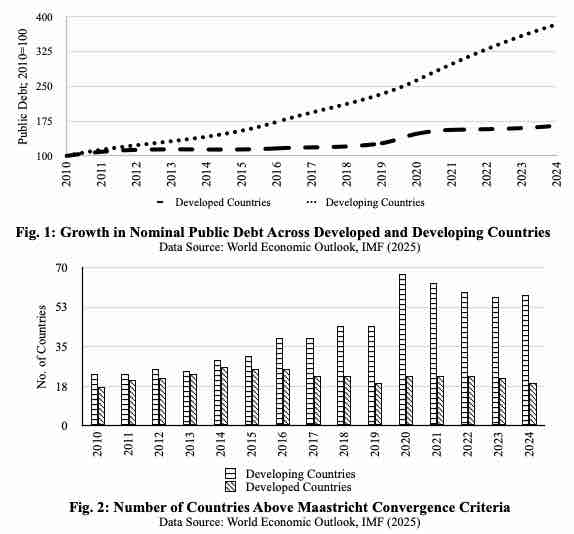
Fig. 2: Number of Countries Above Maastricht Convergence Criteria
Data Source: World Economic Outlook, IMF (2025)
So, what may be done differently to prevent such waves of debt to reoccur. This article is an attempt to underscore the importance of looking beyond conventional measures to understand the sustainability of sovereign debt. It is worth mentioning here that Reinhart et al. (2003) points out that understanding of whether a country can tolerate debt levels is pivotal in exploring the problems with debt sustainability. Countries having high tolerance for debt levels are likely not only to have better fiscal structures and systems but also good institutions and also a history of good economic management. While quality formal institutions have remained an essential determinant to study debt sustainability, but quality of informal institutions have been relatively less prominent. It is worth mentioning here that Bagchi and Majumder (2025) has explored the causal relationship between informal institutions and public debt. Taking a cue from their comprehensive econometric work, we in this article explore the same issue by including additional formal institutions. In doing so, we aim to target a larger audience of policy makers and various stakeholders to explore not only the formal institutions but also the role of informal institutions when it comes to setting up formal policies.
2. Institutions and Debt Levels
To begin with, we construct a sample of 99 countries accounting for nearly 75% of the world’s GDP in 2024. The 99 countries comprise 41 developed and 58 developing countries. To explore whether institutional quality shapes debt management, we consider five dimensions of formal institutions (i.e., electoral democracy, judicial constraints on executive, rule of law, academic freedom and control of media agents) collected from V-Dem and an indicator of informal institutions (i.e., social trust) from the World Values Survey, respectively.
The various dimensions of formal institutions capture different enforcement channels of formal constraints on political intent. They are rather different from being five measures of the same underlying construct. More importantly, electoral democracy, judicial constraints on the executive, and the rule of law are measures of constraints on government power, while academic freedom and control of media agents indicate whether the exercise of government values is visible. Electoral democracy disciplines the government on fiscal spending through the electoral process. Judicial constraints on the executive allow the court to check the executive, thereby increasing the likelihood that money received through debt will be utilized judicially. The rule of law refers to the extent to which government officials comply with the prevailing law of the land. This is a direct measure of enforcement across the legal system, not just upon the executive. Academic and media freedom enhance unbiassed scrutiny of governments policies and fiscal decisions. Altogether if the quality of these formal institutions is better, it generates better accountability of government and credibility of fiscal policy. In other words, it enhances the government’s capacity to manage debt.
In the context of informal institutions, we consider social trust following Arrow (1972) argument that trust facilities economic cooperation and thereby faster economic growth. Social trust shapes citizens’ expectations about how government functions and their willingness to participate in public policy. On its impact on public debt, there could be two competing arguments. First, a higher level of social trust drives better governance structures that suggest greater fiscal discipline and improved effectiveness of public institutions. These institutions eventually ensure controlled debt. On the other hand, high levels of trust may provide the government with greater fiscal space, allowing it to borrow when they believe debt is to be utilized for productive purposes. Altogether, in a country where social trust levels are high, members of society believe that fellow members, including public officials, vis-à-vis formal institutions, are trustworthy and will act when the collective interest is at stake.
3. Evidence
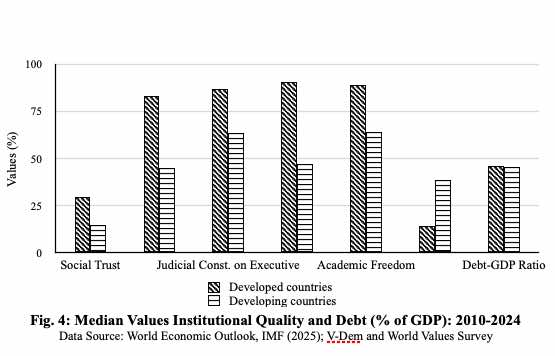
Our analysis of data reveals that developed economies imposes constraints on government power and has better government values, while developing countries are associated with inferior institutional quality; see Fig 4. Such differences in performance levels arise primarily from varying standards of informal institutional quality; see North (1990) and Putnam & Mumby (1993) for similar arguments. Interestingly, developed and developing countries have about the same median Debt-to-GDP ratio despite varying levels of institutional quality. One common argument is that the current debt crisis is not limited to developing economies but also encompasses developed economies; see the BIS Annual Economic Report (2026). Therefore, could all countries be failing to manage public debt? Isn’t the quality of institutions safeguarding it?
Fig. 4: Median Values Institutional Quality and Debt (% of GDP): 2010-2024
Data Source: World Economic Outlook, IMF (2025); V-Dem and World Values Survey
To solve this, we need to disaggregate the data further and understand how the interplay between informal and formal institutional quality affects the country’s debt, irrespective of its development standards. In this regard, Williamson (2009) argues that countries with better informal institutions don’t need to have sound formal institutions. In fact, societies can experience the following: both formal and informal institutions being strong; a strong informal but a weak formal institution; weak informal and a strong formal institution; a weak formal and informal institution. In the first case, a strong informal institution is likely to complement a strong formal institution, while in the second case, a strong informal institution is likely to substitute for a weak formal institution. When the relationship is complementary, the rules of formal institutions are written in light of the constraints set by informal institutions, thereby ensuring enforcement. When the relationship is substitutive, the strong informal institution achieves what the formal institution intended but failed to enforce. Having a weak informal institution alongside a strong formal institution creates incentives for society to behave in ways that differ from the formal rules. As a result, economic progress is affected. Lastly, when both sets of institutions are poorer in quality, economic progress is uncertain. To further explore the quality of institutions and their interplay, one may consult Helmke and Levitsky (2004). To explore this interplay, we prepare a list of countries based on the quartile ranges of social trust and other indicators of formal institutions, as well as the debt-to-GDP ratio; see Table 1. For institutional parameters, with the exception of media control, if a country is placed in a higher quartile, it signifies better quality of institution. For media control, lower quartiles correspond to lower levels of government control over the media and, therefore, greater press freedom. A country in the higher quartile of the debt-GDP ratio signifies greater debt accumulation.
Across different measures of formal institutions, countries cluster predictably. In other words, strong democracies score well on all five dimensions of formal institutions, while authoritarian states score poorly on all five. More importantly, as argued above, we find evidence that social trust entirely breaks this pattern. For instance, countries such as Hong Kong, Vietnam, Saudi Arabia, Iraq, and Yemen have the highest value of social trust but rank the lowest in the quality of formal institutions. On the other hand, countries such as Chile, Peru, Brazil, Colombia, Ecuador, Bolivia, and France score low in social trust but have high values of formal institutions. We argue that countries having a high debt-GDP ratio despite having high levels of social trust (i.e., falling in either Quartile 3 or 4) are expected to manage debt, while countries with limited trust levels but possessing good quality of formal institutions will not be able to manage debt, as the actors will find ways to ignore the laws. In Table 1, we highlight the names of countries we find are less likely to manage debt. The criteria are that, irrespective of the quality of their formal institutions, they should be in the lower quartile range of social trust and have a relatively high debt-to-GDP ratio [i.e., belonging to Quartiles 3 and 4]. It is observed that out of 99 countries, 28 countries make into the list and 26 of them are developing economies.
Table 1: Social Trust, Formal Institutions and Public Debt: An Interplay
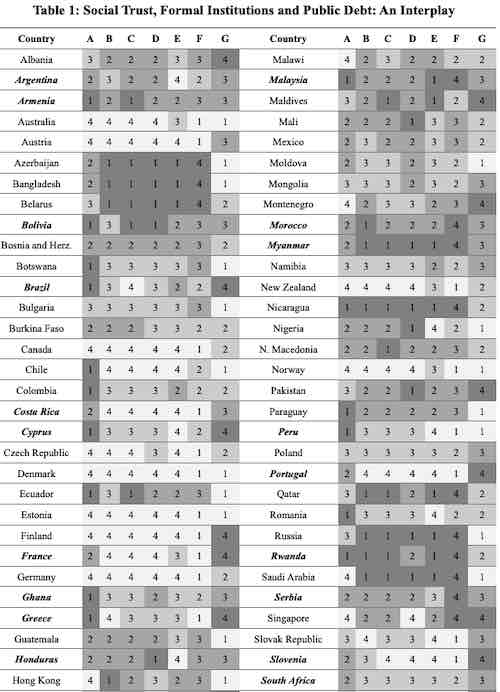
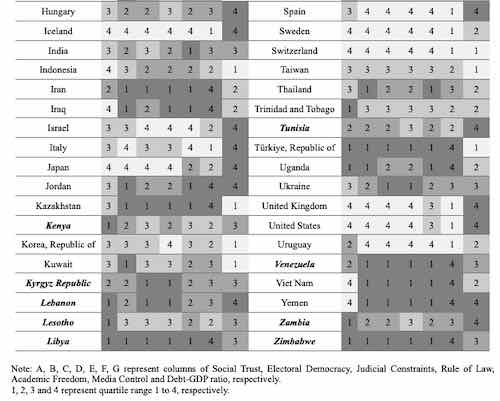
Note: A, B, C, D, E, F, G represent columns of Social Trust, Electoral Democracy, Judicial Constraints, Rule of Law, Academic Freedom, Media Control and Debt-GDP ratio, respectively.
1, 2, 3 and 4 represent quartile range 1 to 4, respectively.
4. Conclusion
The debt wave is not a black swan event; it recurs at periodic intervals and culminates in a crisis. Existing debt sustainability frameworks place much importance on fiscal indicators and the credibility of fiscal policies. Our analysis suggests this to be incomplete. Countries having strong fiscal rules to manage public debt ultimately must rely on society’s willingness to accept it. Therefore, informal institutions make a strong case to assess the sustainability of a country’s debt level and the design of fiscal policy. We further opine empirical research on public debt management should include quality of informal institutions and also enhance the scope of considering more finer measures of formal institutions.
(Authors: Sagnik Bagchi is an Assistant Professor at School of Business Management, SVKM’s Narsee Monjee Institute of Management Studies (NMIMS) Deemed-to-be-University, Mumbai, India. He can be reached at sagnik.bagchi[at]sbm.nmims.edu
Sayantan Bandhu Majumder is an Associate Professor at Department of Economics, St. Xavier’s University, Kolkata, Action Area III, B, Newtown, West Bengal, India. He can be reached at sayantan.bmajumder[at]sxuk.edu.in)
[Note: All views expressed are entirely personal and do not represent in any way the views of the institutions the authors belong to.]
References
- Arrow, Kenneth J. (1972), “Gifts and exchanges” Philosophy & Public Affairs, Vol. 1 No. 4, pp. 343-362.
- Bagchi, S. and Majumder, S. (2025), “Social Trust and Formal Institutions: How do they Shape Public Debt?”, Economics of Transition and Institutional Change, Vol. 33 No. 3, pp. 519-552.
- BIS Annual Economic Report (2026), “High Public Debt and Shifting Financial Markets: Challenges for Central Banks”, https://www.bis.org/publ/arpdf/ar2026e2.htm
- Gündüz, B. Y. (2017), “Debt Sustainability in Low-Income Countries: Policies, Institutions, or Shocks?”, Working Paper No. WP/17/114, IMF.
- Helmke, G. and Levitsky, S. (2004), “Informal Institutions and Comparative Politics: A Research Agenda”, Perspectives on Politics, Vol. 2 No. 4, pp. 725-740.
- Kose, M A., Nagle, P., Ohnsorge, F. and Sugawara, N. (2021). Global Waves of Debt: Causes and Consequences, World Bank Publications.
- North, D. C. (1990), Institutions, Institutional Change and Economic Performance, Cambridge University Press.
- Putnam, L. L. and Mumby, D. K. (1993), “Organisations, Emotion and the Myth of Rationality”, Fineman, S. (Ed.), Emotion in Organisations, Sage Publications, pp. 36-57.
- Reinhart, M C., Rogoff, S., Kenneth, S. and Miguel, A. (2003), “Debt Intolerance”, Working Paper No. 9908, NBER.
- Tabellini, G. (2008), “Institutions and Culture”, Journal of the European Economic Association, Vol 6 No 2-3, pp. 255-294.
- UNCTAD (2026), “The Rising Cost of Debt is Squeezing Development Prospects in Many Countries”, https://unctad.org/news/rising-cost-debt-squeezing-development- prospects-many-countries
- Williamson, C. R. (2009), “Informal Institutions Rule: Institutional Arrangements and Economic Performance”, Public Choice, Vol. 139 No. 3, pp. 371-387.