 Mainstream Weekly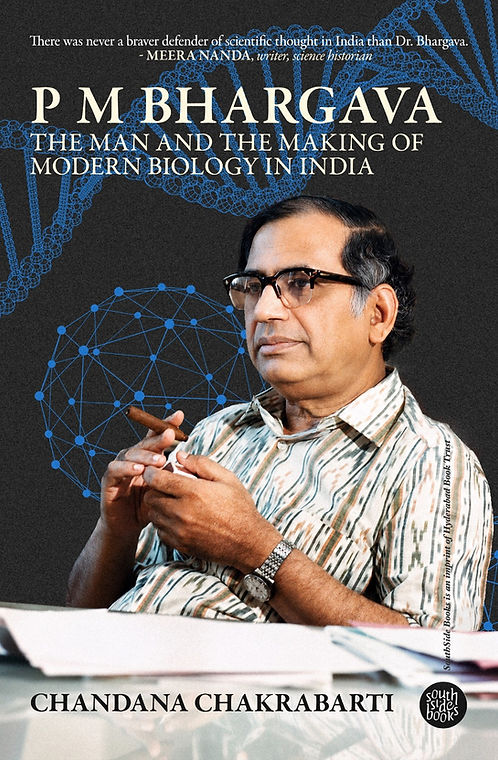
The Man and The Making of Modern Biology in India
by Chandana Chakrabarti
SouthSide Books
. . . a set of episodes that cut across institutions and disciplines . . . when Prof PM Bhargava (PMB) chose to intervene rather than stay silent.
Indo-US Vaccine Action Programme
PMB did not suffer from the usual afflictions that scientists often acquire along the way: the ivory-tower syndrome, cultivated social detachment, policy indifference, fear of taking positions, or a belief that engagement was somehow unbecoming. He was alert to what mattered beyond the laboratory and was never reluctant to intervene when the stakes were high, regardless of consequences. And there were consequences.
The Indo-US Vaccine Action Programme (VAP), an MoU signed on 9 July 1987, was one such moment. Signed by US Ambassador John Gunther Dean on behalf of the United States and S. Ramachandran for India, it covered cooperation across vaccine research, diagnostics, field trials, quality control and delivery systems.
The fine print, however, told a different story. The programme enabled the US to test advanced vaccines, including genetically engineered ones, on Indian populations. It also granted access to epidemiological data and to Indian blood and serum samples. Such material reveals a population’s genetic and immunological profile, its herd structure, and is considered strategically sensitive because of its potential misuse in population-specific biological warfare.
The agreement also bypassed process. It was signed without consulting the high-powered Scientific Advisory Committee of DBT, of which PMB was a member, even though DBT was to be the implementing authority on the Indian side. A small group of scientists and journalists began questioning it. PMB saw it as a serious compromise of national sovereignty and took the lead in challenging it publicly.
He was quoted extensively in the national press and in Nníuuc (10 September 1987). His criticism was blunt enough for the Vice President of CSIR to send him a telex asking whether he had indeed given those interviews and whether he had been misquoted. PMB replied that he had given every interview and that he stood by every word.
On 20 September 1987, the US Embassy sent its Science Attaché, Philip Schambra, to Hyderabad to ‘have a word’ with PMB. This was followed by an attempt to bring pressure through Edwin Becker, speaking to him on behalf of NIH Director, Jim Wyngaarden, urging PMB not to oppose the programme. Schambra also produced a statement signed by several Indian biologists supporting VAP, typed on US Government stationery with the eagle watermark. PMB was unconvinced.
A meeting with the US Ambassador was arranged on 27 September 1987, late at night, to coincide with PMB’s visit for a special meeting of the Indian Science Writers’ Association (ISWA) the next morning, where he was to speak. His flight from Hyderabad was delayed, and he arrived in Delhi at 11 pm instead of 9. Schambra was waiting. Since the Ambassador had to leave Delhi urgently, PMB was taken close to midnight to meet the Deputy Chief of Mission instead. PMB had insisted that the CSIR car follow them, despite the Embassy having arranged transport.
Asked why he was opposing the programme, PMB restated his objections and posed a question he had already asked Becker: what would you do if the roles were reversed? He was told that his friend M.
G. K. Menon had no objection to VAP. That made no difference to PMB. Polite conversation followed. Wine was offered and declined. There were inquiries about his children and whether the Embassy could do anything for them.
When the Deputy Chief of Mission realised that PMB intended to speak his mind at the ISWA the following day, the cordiality vanished. His tone hardened. He handed PMB a typed sheet of paper and stated, without ambiguity, that the US Ambassador expected PMB to read it out at the meeting. The statement said, in effect: “I, P. M. Bhargava, do not doubt the intentions of the US Government and fully support the VAP.” PMB replied that what he would say the next day would be reasonable and defensible anywhere, at any time, and rose to leave.
What followed was a brief but pointed contest. The Deputy Chief of Mission tried to retrieve the paper. PMB, having already decided otherwise, refused to return it. The eagle watermark on the sheet mattered. It showed that the statement had been prepared by the US government, almost certainly within the Embassy itself.
The next morning at ISWA, PMB opposed the VAP unequivocally and also described what had transpired the previous night. An enquiry followed from the Prime Minister’s Office. A stronger Indian delegation was appointed to the Joint Working Group of VAP. PMB was included. The episode unfolded barely months before the dedication of CCMB. The German, Russian, and Chinese Ambassadors, the British High Commissioner, and a letter from the French Ambassador marked the occasion. The US Ambassador did not attend.
The first meeting of the Indo-US Joint Working Group was held in New Delhi on 2–4 March 1988. On the evening of 3 March, Ambassador John Gunther Dean hosted a dinner for the group. Turning to Nobel laureate Fred Robbins, he asked how the meeting had gone. “Ask Dr. Bhargava”, Robbins replied. The Ambassador turned his back and walked away.
[ . . . ]
Resignation from the Three Science Academies
PMB, who had been elected a Fellow of the three national science academies—the Indian National Science Academy, the Indian Academy of Sciences, and the National Academy of Sciences—by 1978, resigned from all three in 1993. It was an unusual step. Possibly for the first time in the history of Indian science academies, a Fellow chose to relinquish the honour voluntarily.
What troubled PMB was not personal grievance but the conduct of the academies themselves. Given their standing, he found them inert and ineffective, particularly in matters where a rational and public scientific position was called for. Their silence in the face of irrational claims made by scientists and political leaders in positions of authority disturbed him. So did their reluctance to engage with policy issues, and their failure to function as a socially responsible collective.
He was equally critical of how the academies functioned internally. The system was undemocratic and wasteful. The outgoing Council nominated the incoming one, after which the nominated slate was circulated for voting. Fellows could strike out a name and suggest
– another, but unless a majority struck out the same name and replaced it with the same alternative—an obvious impossibility—the outcome remained unchanged. The exercise, in effect, served only to endorse a pre-decided result.
PMB’s resignation from all three academies was widely reported in the press in the first week of January 1994. What was perhaps more revealing than the coverage itself was the private response. Several Fellows contacted him to congratulate him on leaving.
[ . . . ]
Returning the Padma Bhushan
PMB received the Padma Bhushan award in 1986. It was one of four awards he valued, the others being Legion d’Honneur from the President of France, the RD Birla award, then the highest monetary award in the country, and the National Citizens Award, which he received with Smita Patil, Vishwanath Anand and Justice P. N. Bhagwati.
In October 2015, a large number of writers returned their Sahitya Akademi awards in protest against the killing of three rationalists and the growing atmosphere of intolerance, along with the shrinking space for dissent under the BJP government. What troubled PMB at the same time was the open political agenda of the BJP and its parent organisation, the RSS, which he believed was pushing the country away from democracy towards a Hindu theocratic order. This, for him, crossed a line.
At eighty-eight, in failing health and no longer able to intervene as he once had, PMB had few options left to make dissent visible. Writing no longer seemed to suffice. If he was to be heard, he felt he had to part with something that mattered deeply to him. Returning the Padma Bhushan, a state honour, seemed the only remaining option.
On 28 October 2015, Arun Ram from Thc Times of India called PMB to ask some questions about a statement regarding the return of the Sahitya Akademi awards that carried PMB’s signature. PMB disclosed his decision to return his Padma Bhushan.
The Times of India carried the decision on 29 October 2015 as a front-page headline. News channels arrived at his home and stayed through the day. The next day, newspapers across the country, in multiple languages, carried the story prominently. The BJP responded with a hurried press conference marked by personal attacks and denunciation.
On 3 November 2015, The Hindu published PMB’s article explaining why he returned the award. More than 250 emails followed, roughly two-thirds supportive and the rest sharply critical.
Across institutions, governments and decades, the pattern was consistent. When scientific judgment collided with public harm or institutional evasion, PMB chose to intervene. Not because he believed he would prevail, but because silence, in such moments, was not an option.