 Mainstream Weekly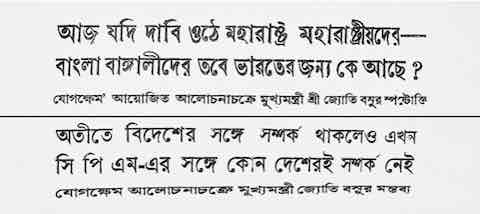
Headlines of the two-part report on Jyoti Basu’s lecture published in Swastika on 25 July and 1 August 1977.
With the Bharatiya Janata Party’s victory in the 2026 West Bengal Assembly elections, Hindu nationalists’ long-cherished dream of winning over Bengal has finally materialised. Significant in many ways, this political development will undoubtedly invite rigorous scrutiny and, in attempting to make sense of it, looking back at the past remains indispensable. As Jawaharlal Nehru observed in The Discovery of India, “Not to understand [the past] and feel it as something living within us is not to understand the present.” In the course of such an inquiry, a small yet significant historical fragment comes into view, one that this piece seeks to revisit.
Before turning ‘saffron’, or ‘green’ before that, Bengal had remained ‘red’ for thirty-four years under the Left Front, one of the world’s longest-serving democratically elected communist governments. Among many things, this regime is often credited for its commitment to secular principles; nevertheless, how consistently they were upheld in practice is a matter for another debate. What is of concern here, however, is a revealing historical moment. In 1977, the very year the Left Front came to power, Jyoti Basu, who would go on to serve five consecutive terms as chief minister, participated in and delivered a lecture at an event organised by Yogakshema, a Rashtriya Swayamsevak Sangh-backed organisation. Long buried in the pages of Swastika—a Bengali weekly and mouthpiece of the RSS published since 1948—this episode is important not only for unearthing Basu’s lecture itself, but also for understanding what such an engagement between a leading communist figure and a Hindutva platform reveals about the Sangh’s modes of operation in Bengal.
Yogakshema: A Forum for Social Service
At the height of the Naxalite movement in West Bengal, a group of senior RSS swayamsevaks, feeling ‘suffocated’ by the prevailing political climate, came together to form Yogakshema in Kolkata in 1970 as a platform for ‘nationalist intellectual engagement and social service.’ The organisation was inaugurated at the residence of a swayamsevak, Motilal Soni, on Convent Road in Kolkata, with veteran swayamsevak Dr. Sujit Dhar serving as its secretary. Several prominent figures associated with the Sangh ecosystem, including Murlidhar Dattatraya Deoras and Vishnu Kant Shastri, attended the event alongside members of the wider public.
Yogakshema’s activities broadly fell into two interconnected dimensions. On the one hand, it regularly organised lectures and discussion events aimed at nurturing its ideological cause. On the other, it engaged in social-welfare initiatives, thereby translating abstract ideals into tangible public action. In pursuit of the former, the organisation frequently invited well-known personalities to deliver lectures, sustaining member engagement while expanding its reach and social respectability, particularly among affluent and influential sections of society.
As for the latter, documentary evidence suggests that from its inception in 1970 until at least the early 1990s, Yogakshema, despite its limited resources, undertook a range of philanthropic initiatives both within and beyond Kolkata. These included an employment exchange programme, a maternity home, and a child welfare institution, alongside occasional programmes such as contributing funds towards school development and organising blood-donation camps. Taken together, these efforts suggest that philanthropy complemented Yogakshema’s broader mobilisation efforts, as it has for many other Hindu Right formations.
Making Sense of Basu’s Engagement
According to Amitabh Ghosh, a swayamsevak and one of Yogakshema’s founding members, Jyoti Basu was approached by the organisation’s secretary, Dr. Sujit Dhar, with a request to deliver a lecture well before he became Chief Minister. How the connection between Dhar and Basu was established, however, remains unclear. It may have been the result of a straightforward personal approach by Dhar on behalf of the organisation. Equally, given the political context of the period, it is possible that the connection emerged from a broader conjuncture in which sections of the Left and the Right had found common ground in opposition to the Emergency. Dhar’s reported closeness to senior Bharatiya Jana Sangh leaders such as Lal Krishna Advani and Atal Bihari Vajpayee lends some support to the latter possibility. Whatever the precise circumstances, the more pertinent question is what significance ought to be attached to Basu’s participation in the event.
In itself, however, Basu’s engagement provides little basis for inferring any affinity with Hindu nationalism. Neither his political philosophy, nor his one-time participation in this platform, nor the content of the lecture he delivered suggests that he ever displayed an inclination towards Hindu nationalist ideals. It is also worth noting that Basu was by no means the only unexpected figure to have addressed Yogakshema. Alongside individuals closely associated with the Sangh Parivar in various capacities, including Debaprasad Ghosh, Ramesh Chandra Majumdar, Eknath Ranade, Subramanian Swamy, Dattopant Bapurao Thengadi, Kidar Nath Sahani, Shivram Shankar Apte, Ashok Gajanan Modak, and Koenraad Elst, the organisation also hosted numerous prominent personalities from outside the Hindutva fold. These included Saumyendranath Tagore, Jyoti Bhushan Bhattacharya, Mahanambrata Brahmachari, Swami Niramayananda, Swami Ranganathananda, Pratap Chandra Chunder, Kashi Kanta Maitra, Abul Hasnat Muhammad Qamaruzzaman, and Hamid Umar Dalwai. To infer Hindu nationalist sympathies from Basu’s participation alone would therefore be no less problematic than drawing the same conclusion about many of these other speakers.
The significance of the incident, therefore, lies elsewhere. Rather than indicating any ideological proximity between Basu and Hindutva, it reveals how Sangh-backed organisations in Bengal often operated by obscuring their ideological affiliations and objectives. While this was by no means unique to Bengal and reflects a broader pattern identified by scholars studying the RSS in different contexts, the case of Yogakshema offers a particularly revealing illustration. Basu’s participation, like that of many others, may thus be understood as a consequence of limited awareness of the body’s ideological moorings, a circumstance that nonetheless conferred upon it a degree of social legitimacy and respectability, helping it sustain itself within an otherwise unfavourable political environment.
A few additional episodes further illuminate the extent to which Basu and his government appear to have had only a limited understanding of the operations of the Sangh Parivar during this period. In 1978, for instance, Basu did not object to the relief work undertaken by Banyarta Seva Samiti, another RSS-backed body, among flood-affected residents of Durlabhpur village in Howrah. This may have been because he saw no reason to oppose such activities, or because he was unaware of the organisation’s backing. The latter possibility gains some support from subsequent developments. On 16 March 1979, Basu stated in the Assembly that no activities of the RSS had come to the government’s notice that were directly disrupting communal harmony in the state. Again, on 22 February 1980, responding to concerns raised by several MLAs in light of certain developments, he remarked that “there has not been much spurt in the activities of the R.S.S. in the State,” while simultaneously acknowledging that ‘the government had information indicating that the RSS had increased the number of its branches, organised training camps, and held meetings in various locations.’ Considered together, these statements reveal a certain tension in the government’s assessment of the RSS and suggest that neither Basu nor his administration fully appreciated the extent of the organisation’s presence in the state, let alone that of its affiliated bodies.
The Lecture
[The following is a translation, rendered as closely as possible to the original text, of an excerpt from Jyoti Basu’s lecture as published in Swastika on 25 July and 1 August 1977, delivered at an event organised by Yogakshema at Maharashtra Niwas in Kolkata on 17 July 1977, just twenty-six days after he was sworn in as Chief Minister of West Bengal under the first Left Front government.]
Thirty years after Independence, West Bengal and India as a whole remain entangled in a web of problems. We should have developed a far more advanced system by now, but that has not happened. One problem after another continues to surround us. It is true that a few large cities have grown here, but the condition of villages across the country remains deplorable. The middle classes, workers, peasants, and others—constituting nearly seventy to eighty per cent of the country’s population—continue to live in extremely poor conditions.
Refugee Problem
There are several reasons behind the problems of West Bengal. After Independence, six to seven million people were compelled to migrate here from East Pakistan. Thereafter, repeated outbreaks of communal riots and disturbances forced several hundred thousand more people to move to this side. No other state had to bear the pressure of such a massive population influx. Punjab, too, had faced a refugee problem, but there the issue was resolved through an exchange of population.
Jawaharlal Nehru had said that the refugee problem originating in East Pakistan was a problem of the entire country, but in practice it became evident that his government forgot all the promises it had made to them. With the assistance of various political parties and social organisations, the displaced persons settled wherever they could. They were compelled to adopt various illegal means, such as forcible occupation of land, because the law was not on their side. As a result, police repression occurred in many places. But what else could they do? They had to survive. Neither the central government nor the West Bengal government came forward to assist them. Consequently, the refugee problem remained a permanent problem here.
Neglected in Multiple Ways
West Bengal has also been neglected in various other respects. The Centre told West Bengal to increase the production of jute, since jute earned the highest amount of foreign exchange. We were told that they would arrange for the rice we needed. Consequently, the peasants of West Bengal increasingly cultivated jute, but no adequate arrangement was made for our rice supply. We thus remained deprived.
West Bengal has historically had a relatively developed industrial base—this had been the case since the colonial period—but over the past thirty years there has been no significant industrial development here. Meanwhile, in other states of India, industry has advanced at a very rapid pace with the help of new machinery and more advanced technical knowledge. Owing to the lack of capital investment, industry has not expanded here.
At one time, because West Bengal was industrially advanced, people from across eastern India came here in search of livelihood. However, there was no well-conceived plan for their employment. As a result, they continued to arrive here in waves and crowded into the state. Consequently, the problem of unemployment in West Bengal became more acute than anywhere else. No other state faced the problem with such intensity. Thus, West Bengal fell behind while other states moved ahead.
Not Only in Economic Terms, but Also in Political Terms
One unjust aspect is that prices are not uniform throughout the country. Iron and coal from West Bengal are sold at the same price across India. Yet goods produced in other states, such as cotton or oil, are not sold at uniform prices in every state; in some states the prices are lower, while in others they are higher. The question of uniform pricing is not merely an economic matter, but also a political one. If prices are not equal, it encourages divisive tendencies. Naturally, the question then arises: is India truly one country?
Among the working classes of West Bengal, the influence of the Left has been strong, and they have never allowed provincialist sentiments to raise their head here. Yet in certain states, circulars were issued by governments and industrialists instructing that preference should be given to local persons. In Maharashtra, movements were organised against South Indians. If demands continue to emerge from all sides that Maharashtra belongs to Maharashtrians, Bengal to Bengalis, and so on, then I would ask: who, then, stands for India?
We have already asked the Government of India why such circulars had been issued. In West Bengal, nearly sixty per cent of industrial workers are non-Bengalis. Apart from Maharashtra, such a situation exists nowhere else. Some industrialists—I do not wish to mention their names—bring in workers from outside Bengal whenever labour is required. Had this been limited to specialists, I would have had nothing to say, because in such cases recruitment should naturally be conducted through all-India examinations. But even for ordinary work, labourers are brought from outside.
Factories have been established in refugee-dominated areas, yet qualified refugee youths there have not been given employment; instead, jobs have been given to outsiders. There are also many people here who have come from outside and have been working here for generations. This is not an injustice. They are our people as well. They will certainly work here. However, local youths must also be given opportunities.
During the period of the previous United Front government, some industrialists threatened me by saying that labour unrest was increasing and that, if this continued, they would shift their industries to other states. I told them that even if industries were relocated elsewhere, labour unrest would arise there as well, because workers would gradually become conscious of their trade union rights. The industrialists themselves admit that the best workers are found in West Bengal. In fact, workers from West Bengal have spread across the whole of India. Yet they continue to receive fewer opportunities and benefits.
The Question of Priority
Many people ask me which among the problems of West Bengal should be given priority. But every problem here is acute. Which one, then, should I single out for priority? Even drinking water is a problem here—not only in the villages, but also in the cities. The overall situation is extremely deplorable. We have experienced deterioration in every sphere.
Of the cultivable land in West Bengal, only around twenty-five per cent has been brought under irrigation. The situation in Maharashtra is much the same; outside Poona and Bombay, conditions are very poor. I once visited Maharashtra during a drought. In discussions with the Chief Minister there, I learned that only about twenty to twenty-five per cent of cultivable land in that state was under irrigation. In Punjab, however, the situation is considerably better in comparison, though this is because a good irrigation system had existed there since the colonial period.
Due to the lack of irrigation, the condition of agriculture in West Bengal is extremely poor. Land reforms have still not been implemented here. Land remains concentrated in the hands of a small minority. In fact, nowhere in India have land reforms truly been carried out. We are now considering which among these problems should receive what kind of priority, and are formulating various kinds of short-term and long-term plans.
The Youth Problem
One of the major problems of West Bengal is the problem of the youth. The younger generation has been led astray. Political parties are using them to serve their narrow interests. The number of unemployed persons registered with the Employment Exchange stands at 1.9 million. There may be another 1.9 million who have not registered their names at all, because registration produces no result. As economic pressures continue to increase, women, too, are entering the workforce in search of employment. Consequently, the problem has become even more severe.
On Corruption
There is rampant corruption at every level, from the top down. If this corruption could be curbed, the effectiveness of investments made in various sectors would increase substantially. It must also be remembered that corruption begins at the top. Businessmen say that it is impossible to run a business honestly without engaging in corruption.
A lorry owner once told me that, in order to operate his vehicle, he had to spend nearly five hundred rupees a month in bribes to the police. I do not, of course, know how he accounts for such expenses in his records. This corruption constitutes a major problem, and indeed an all-India problem. Everyone must unite in the struggle against it.
Relations with the People
We must maintain close relations with the people. The difficulty is that, once elections are over, we no longer remember the public. After five years, we return to the voters and say: mistakes were made; we could not remain in contact with you for so long. Very well, from now on we shall maintain contact—now please vote for us. This is not right.
We must work together with the people. It is true that, in order to run the administration, one has to rely on the police and the bureaucracy. But they are not everything. We must seek assistance from all kinds of organisations—social and political organisations, teachers’ organisations, workers’ organisations, institutions like yours, and every other kind of organisation.
You should inform us about your needs and difficulties. We shall try, to the best of our ability, to resolve them. And where we cannot do so, we shall state that openly as well. But cooperation must function in both directions; it cannot be one-sided.
In short, the people must not be deceived. Let them see where we are making progress and where we are encountering difficulties.
Mistakes Must Not Be Allowed to Grow
During the recent Emergency, the democratic system had been reduced to ruins. Such a thing must never be allowed to happen again in the future. A sense of fear had taken hold of people’s minds. No one had the courage to speak the truth.
We are telling government officials that, if they detect any shortcomings in our circulars or directives, they should inform us of them without fear. If necessary, we shall amend them. Many people believe that one becomes omniscient upon becoming a minister. We do not belong to that school of thought. Therefore, if we make mistakes, we are prepared to correct them. We shall not allow mistakes to grow.
Scientific Socialism
Under the Constitution that exists in our country, the scope for achieving progress according to our own views and methods remains limited. The socialist system that we envision cannot be established within the framework of this Constitution. Our method is that of Scientific Socialism.
At present, however, we cannot think in terms of advancing along that path. Therefore, we shall work within the existing situation. The Government of India has long spoken in the name of socialism, but in practice the system has remained capitalist in character. We do not share common objectives with the Janata Party on every issue. Nevertheless, at present we have decided to work together on matters where there is broad agreement.
In any socialist system, monopolies cannot develop. Yet here they have emerged. Nearly seventy per cent of the population lives below the poverty line. A small section has grown progressively wealthier, while the rest have become increasingly poorer. We believe that this situation can be transformed through a change in the capitalist system.
The Need for Industrial Development
We want the development of industry in every sphere through state initiative. But for this, the people must first be properly prepared and organised. Monopoly business must be brought under control, and cottage industries must be encouraged.
Today, in matters relating to pulses, spices, cloth, and almost every essential commodity, we remain dependent upon the mercy of a particular class of people. These forces cannot be restrained through any kind of ‘gentleman’s agreement.’ They must be properly regulated. The central government must address this matter.
Another major problem is that the distribution system is not functioning properly. Produced goods are not reaching the people in an adequate manner. Recently, the Union Minister Shri Mohan Dharia visited here, and I discussed this issue with him. At the very least, the distribution system for certain essential commodities must be properly organised.
CMDA (Calcutta Metropolitan Development Authority)
It is not that the CMDA has done no good work. However, people are unable to remember its positive contributions because, once a project is completed, no attention is paid to its maintenance. Here, officials from different departments dig up the roads, but it appears that no one assumes responsibility for restoring them afterwards. In reality, there is a lack of coordination among the various departments.
A Call for Work
The people have placed their trust in us. They now expect work from us. We shall not be able to escape responsibility by offering excuses. In this task, I seek the cooperation of all of you.
Question and Answer Session
At the end of the speech, during the question-and-answer session, Shri Basu stated that he had received assurances of every possible cooperation from the central government. He also said that efforts were being made to resolve the electricity crisis. In this context, he remarked that neither he nor his party agreed with many of the propositions associated with Eurocommunism. He further stated that they wished to apply Scientific Socialism in accordance with the conditions prevailing in India. Although they had maintained relations with foreign countries in the past, they no longer had relations with any country.
In response to another question, Shri Basu stated that the government would maintain cordial relations with opposition parties and that they would work through discussions and consultations at various levels, particularly with members of the Janata Party.
One speaker asked whether, if his party came to power at the Centre, they would uphold freedom of the press, freedom of expression, and the independence of the judiciary. Shri Basu replied that, if they came to power through bloodshed and revolution, they would not permit such freedoms, because in that situation only one party would exist. He noted that this had occurred in other communist countries across the world, and asked why they would provide opportunities to their enemies. However, he added that if they came to power through parliamentary democracy, they would certainly abide by democratic norms and procedures.
At the beginning of the programme, Shri Amitabh Ghosh explained the objectives and ideals of Yogakshema and introduced the speaker. The vote of thanks was delivered by Dr Sujit Dhar, General Secretary of Yogakshema.
(Author: Sufal Bepari, currently pursuing a PhD in the Department of Political Science at Vidyasagar University in Medinipur, West Bengal, India)
References
- Swastika. February 7, 1972; April 23, 1973; March 17, 1975; July 25, 1977; August 1, 1977; December 4, 1978; November 19, 1979; July 11, 1983; January 2, 1984; December 23, 1991; November 15, 1993; October 27, 2008.
- Nehru, Jawaharlal. The Discovery of India. Delhi: Oxford University Press, 1994, p. 21.
- West Bengal Legislative Assembly. 1979. Official Report: West Bengal Legislative Assembly, Seventieth Session (Vol. 70, No. III, February–April 1979), p. 387. https://lalib.wb.gov.in/Elibrary_VirtualPath/3/3_304.pdf
- West Bengal Legislative Assembly. 1980. Official Report: West Bengal Legislative Assembly, Seventy-Second Session (Vol. 72, No. I, February 1980), pp. 234–235. https://lalib.wb.gov.in/Elibrary_VirtualPath/3/3_311.pdf
- Hindu Samhati Global Media, New York. “Dr. Sujit Dhar Is No More.” October 10, 2008. https://hindusamhati.blogspot.com/2008/10/dr-sujit-dhar-is-no-more.html